
Work and Community
We often desire to be involved in work that we like and has some meaning for us, where we feel that we are making a valued contribution to the common good.
Yet we may find ourselves in work that we think of as “just a job”, something we need to do to put food on the table. And we stay in that employment for a number of reasons including the unavailability of other work, not having qualifications or skills needed for other choices, and commitments which prevent us from taking on the type of work we would prefer. So we work, making the best of what’s available and we hope for opportunities where we have more choice. Our community life benefits extraordinarily from voluntary unpaid work, where people’s experience, gifts and skills are developed and always given generously. Work is not one thing — we identify it as necessary and also distinguish it as employment, or a job, a ministry; as fulfilling, worthwhile or mundane, and as a contribution.
Catholic social teaching on work, employers, workers’ rights and conditions highlights the contribution that all work makes to the common good. And it is quite specific that workers are to be treated with human dignity by employers attending to their fair payment, safe and healthy working conditions, and sufficient time from work in which to relax, attend to family and community. Church teaching warns employers of developing a greed for profit and blinding them to the value of their workers and of the environments in which they work. When people are desperate for employment, it is not a situation to exploit by depressing workers’ wages and conditions.
This 221st issue explores the social justice teaching on work from the first encyclical, Rerum Novarum (1891), to our own times. Jim Consedine tells of how the encyclical came about and how workers’ unions exercise solidarity to protect workers. He points to unjust practices which inhibit workers from belonging to unions in our working climate now. Christina Stringer outlines where in New Zealand today these principles upheld by Church and government are failing and our migrant workers are being exploited.
Then we have a series of short articles by writers sharing about their work — paid and unpaid — and why they have chosen it. They share the highlights, the relationships developed and discuss some of the lows.
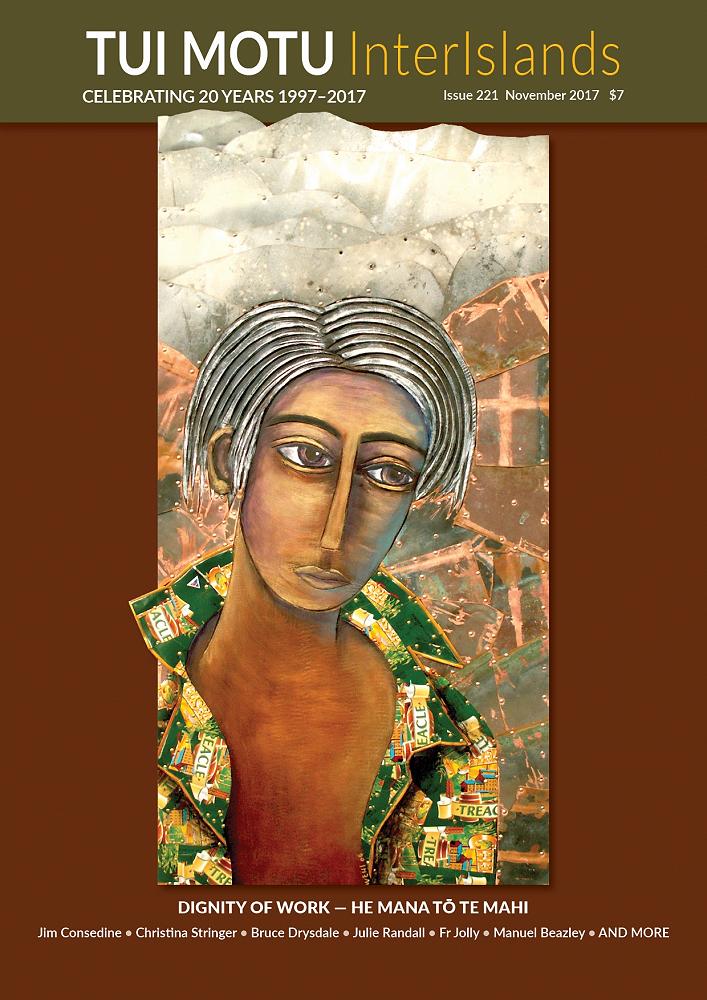
We thank all who have contributed their work to this November issue. Alan Wehipeihana’s sculpture — wrought from treacle tins — graces the cover and the work of other writers, artists and craftspeople combines to make this magazine.
And as is our custom, our last word is of blessing.
Tui Motu magazine. Issue 221, November 2017: 2.