Wake up to compassion
Alice Snedden reflects on how easy it is to ignore needy people as if they were invisible and what happened when she changed and related to them as real people.
In the months leading up to moving to New York I spent some time in Cambodia. It’s a largely rural country still recovering from a relatively recent war and persecution. The people are almost inexplicably friendly and hospitable, despite many of them living below the poverty line. Homelessness is prevalent and begging for money on the streets is commonplace. It’s not unusual to be approached by five or six-year-old children crying for money. Their parents watching from the street across, encouraging them, hoping to maximise on tourist sympathies.
Guidebook advice
Guidebooks urge you not to give them money. They say it encourages parents to keep their kids on the streets, where they can earn their families a living, instead of putting them in school. While this might not paint these parents in a flattering light, when money is so scarce, it is not difficult to imagine why they choose this short-term solution.
I accepted this rationale. When these children approached me crying, I said: "no". Initially it felt callous and cruel, but quickly I adjusted. It didn’t take long to separate myself from what I saw, and soon my dismissiveness felt normal. I became used to the beggars in inadequate clothing, with visibly poor health, and mostly I became comfortable ignoring it.
Friend's advice
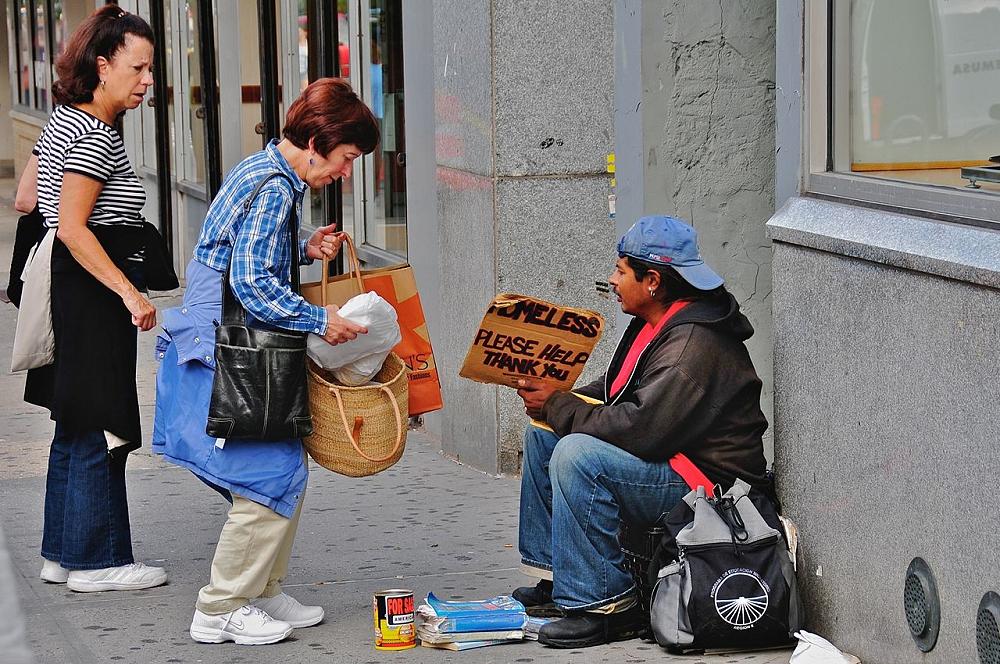
On my second night in New York I took the subway from Brooklyn to the Lower East Side of Manhattan. On this night, each train I rode had pan handlers. “Pan handlers” is the name given to people who ride the subways making speeches and asking for money. My friend, the only person I knew in New York, had warned me about this. “Don’t make eye contact," he said, “and just ignore them”. So I did just that. I looked down, I pretended not to hear, I turned the music in my headphones louder. I did the same with people begging on the streets. I behaved as if they didn’t exist. When I talked to other people about their approach, we would despair at the situation, and then agree that giving money didn’t help.
A different voice
One of my first jobs in New York was as a dog walker. All of my work was on the Upper East Side for people in multimillion-dollar apartments. The contrast between the lifestyle in New York and Auckland is severe/enormous. The winters are much harsher and the summers are hot and humid. During the winter, this job became especially hard. Often the temperature was below 10 degrees and when it snowed, the roads were slippery. The dogs would be reluctant to go outside, so I would dress them in warm coats and booties and cajole them out onto the streets where we would walk past people asking for money.
One morning, while on a dog walk, I listened to a podcast about approaches to helping those living on the streets. It argued that you should decide on a sum of money, they suggested one dollar, and to every person who asked, give one. Further, it said, stop and ask if they need help. The argument was that regardless of public policy, or abstract debate about what the best long-term goal was, this was the most effective way to remain sensitive to the struggles of others and to show compassion.
So I began instead to follow this practice and I found that it was right. Responding when people ask for money or help reminds you that they are there. It makes you stop and take notice of your surroundings and it makes it more difficult to accept the status quo as an inevitable reality.
Changing my approach
One particularly cold evening, I was rushing through a subway station in midtown, late to meet a friend. I had my headphones in and wasn’t paying attention to much. Sitting on the steps of the subway entrance was a woman with a small child in her lap. At first this didn’t even strike me as unusual. So much so, that when I saw the woman was saying something to me, I assumed she was being friendly. When I walked past, I smiled and returned what I thought had been a “Hi”.
It wasn’t until I got to the top of the stairs that it struck me as strange that she’d be sitting in the cold with a small child so late at night. I turned around and walked back down to her.
Once I looked more closely I saw she had been crying. I saw that her child was cold and I saw that she was not saying “Hi” to passers by — she was asking for money. I had nothing to give this woman. I didn’t have any cash, I had no money in my bank account, I was meeting a friend only because she’d said it was her shout. I asked the woman what she needed help with and if she had somewhere safe to go that night. She said she just needed enough money for a ticket to New Jersey. There was a place there she could stay. I began to apologise that I didn’t have any money, but before I could finish another woman stopped and asked if everything was ok. She offered money, and then another person stopped too and offered assistance. The woman wasn’t just another person on the street asking for money, she was a mother with her child in a desperate situation. Even though I couldn’t help her, it was as they had said in the podcast, when you stop and take notice, others will too.
What I realised is, as with most things, people have moveable thresholds and tolerance. We are so malleable that we can accept and adjust to almost any environment around us. So despite being shocked and saddened by what I saw when I first arrived, I adjusted. My threshold for witnessing terrible situations and misfortunes increased and my reaction dulled. It doesn’t take much then to reflect on how I have become complacent in my attitude at home in New Zealand. To reflect on what unacceptable circumstances in my own country, or in any of the communities of which I am a member, I have wrongly accepted as concrete. I wondered what role I had played in facilitating poverty, inequality or prejudice through my own willingness to embrace the notion of a certain degree of suffering as an inevitable reality.
Alice Snedden is a law and political studies graduate
who has just returned to living in Auckland.
Gallery