
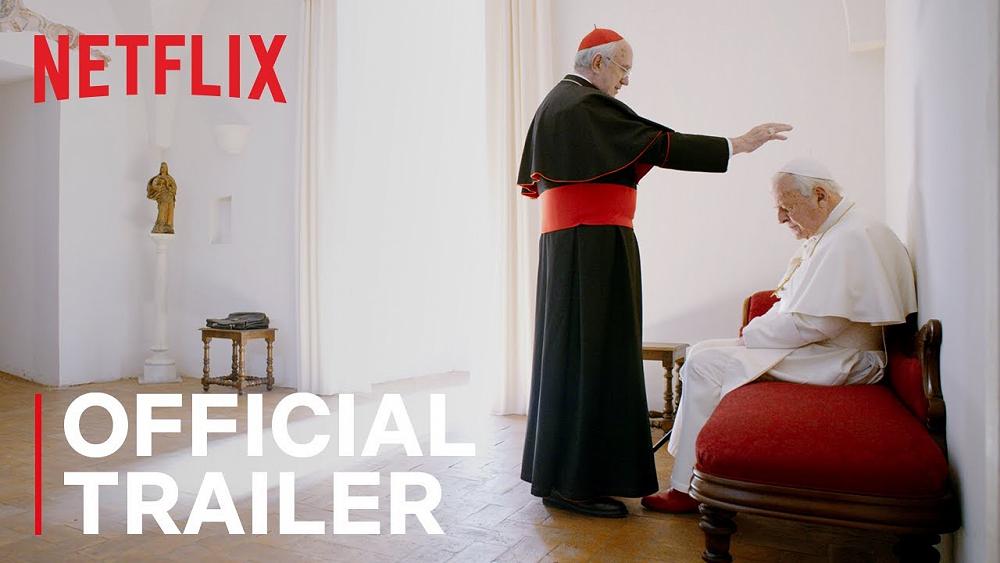
The Two Popes
Directed by Fernando Meirelles. Reviewed by Paul Sorrell
If I was to choose a metaphor to describe this film, it would be the dance — Francis (played by Jonathan Pryce) and Benedict (Anthony Hopkins) moving around each other, sometimes warily, sometimes with abandon, but always treating the other with courtesy and respect. The brief scene where Francis (then, of course, still Cardinal Bergoglio) attempts to teach Pope Benedict some basic tango steps brings the metaphor to life.
The film sets out to overturn preconceptions about the two men — Benedict as the dour intellectual and hardline conservative, Francis the radical who threw the rule book out the window. About halfway through the film we realise that these dancing partners have effectively changed places. Visiting Benedict at the pontiff’s summer residence of Castel Gandolfo to tender his resignation as archbishop of Buenos Aires, which Benedict refuses, Bergoglio then finds himself having to dissuade the Pope from carrying out his own plan to vacate the Petrine office.
Despite this interchange, the two protagonists are not presented in equal depth. We are given Francis’s back story in considerable detail, including his early attraction to football and to the young woman who looked set to become his wife, as well as the controversial years during the brutal rule of the military junta in Argentina, when his attempts to protect the Jesuits under his authority cast him as a collaborator in the eyes of many.
Benedict, by contrast, is not given a past life — we see him as a defeated, isolated, rather curmudgeonly figure who is nonetheless invested with humanity and the capacity for love. It is his spiritual insight that finally compels him to give up the papacy: “I can no longer hear God’s voice”.
There is so much that is fine about this film. The depth of feeling and understanding, the humanity of both men and the wonderful sets, from the garden at Castel Gandolfo to the splendours of the Sistine Chapel where the two popes cast almost jaunty figures as they sit beneath Michaelangelo’s great frescoes. Above all, the dialogue — by Kiwi screenwriter Anthony McCarten — is fresh, witty and humane. How often in a movie are we privy to a conversation about the spiritual life that excites and stimulates us, rather than making us wince in embarrassment?
I’m uncertain if The Two Popes will have a general release – I saw it with friends on Netflix – but be sure not to miss this memorable and beautiful film.
Tui Motu Magazine. Issue 246 March 2020: 29