
Looking Out and In — December 2018
KAAREN: My mother, Beulah Baldwin, daughter of Waikato sheep farmers, trod the first steps in her faith journey in the stern, earnest but organic faith of the Open Brethren at Kensington Street Gospel Chapel, Putaruru. Later, as a high school teacher studying for a Bachelor of Divinity, my mother married Brian Wood. Together they worked for 13 years in international and national schools in India and Nepal where I was born and spent my childhood. From my earliest years, my mother modelled the value of a personal devotional life. A morning “quiet time” with prayer, Bible reading and stillness in the presence of God was a requisite rhythm for her, before launching into her busy day.
My father’s tragic death in the mountains hurled our family into turmoil. Beulah, widowed with four young daughters (we were aged 4 to 11 years), returned to live in Putaruru. To chart her own path out of loss, she started writing.
“Hope is . . .” and “A promise is . . .”were small devotional books that Beulah wrote, marking out signposts of the faithfulness and presence of God in the early days of her grief. In the ensuing decades, my mother wrote about life and faith in New Zealand and then wrote during a further 17 years in India as faculty at a post-graduate evangelical seminary. Now in her eighth decade, she is actively engaged in leadership in the Baptist Church in New Zealand.
A thread that weaves across her years, and now into my own life, is writing about life and faith. Writing for me also is a spiritual discipline that helps me condense my thoughts and discern God’s presence in my life. It’s a story that continues. In the next generation, my daughter Shanti, who is studying at Victoria University, picks up the thread:
SHANTI: For as long as I remember, a Tui Motu would arrive at our house about once a month. It arrived quietly, in a brown paper envelope. Opened without excessive ceremony, it would sit around the house, migrating from couch to table to bed as different family members leafed through it.
Eventually, with no great sense of urgency, I would pick it up and flip to the back cover. There I would find my Mum’s column. Usually I didn’t know what she’d written about ahead of time. I might learn something new about her life or see something I had experienced, reflected back at me through someone else’s words.
Earlier this year, I went to a Tui Motu event held in Wellington. There were lots of people there (though I was the youngest by quite a significant margin). It was fascinating, a little strange, but definitely a privilege to meet people who have followed the journeys of my family via this wee column.
I am generally wary of cliché, but I find the term “faith journey” is a perpetually relevant one. For me faith seems more about journey than destination. My mother shares her faith journey in compelling terms. Her willingness to be reflective and to examine her life for the spaces where God is calling her inspires me.
I am an English literature student and a writer. I am good at spinning meaning from other people’s writing. But often I feel trapped in my own life, bound by my own ordinariness. I can examine a poem for meaning or go to an art gallery and feel cultured and intelligent, without feeling that I need God all that much. Examining myself is far harder and often relentless, seeing as I’m trapped in my own head. Reading Tui Motu, the words on the back cover and also inside, remind me that it is good to ask questions and it is good to ask questions of myself and my faith journey. In fact, that’s just what God calls us to do.
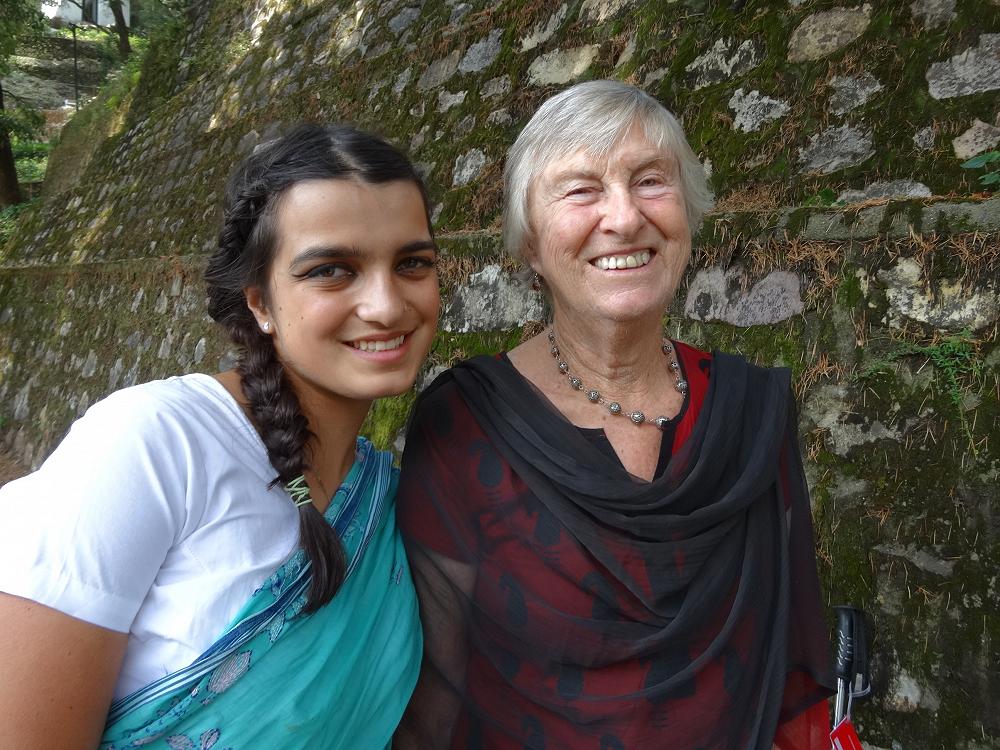
Tui Motu (via "A Mother’s Journal" and "Looking out and In") has provided an audience for the many terrible pictures of me as a child. I’m sorry about the fringe, I’m sorry about the randomly tilted head and gormless expressions. I assure you all that I look much more like myself now.
Tui Motu Magazine. Issue 233 December 2018: 40