
I Must Go
Joey and Gian Domdom speak about the political systems that cause Filipino people to leave their families and seek work overseas in order to support them.
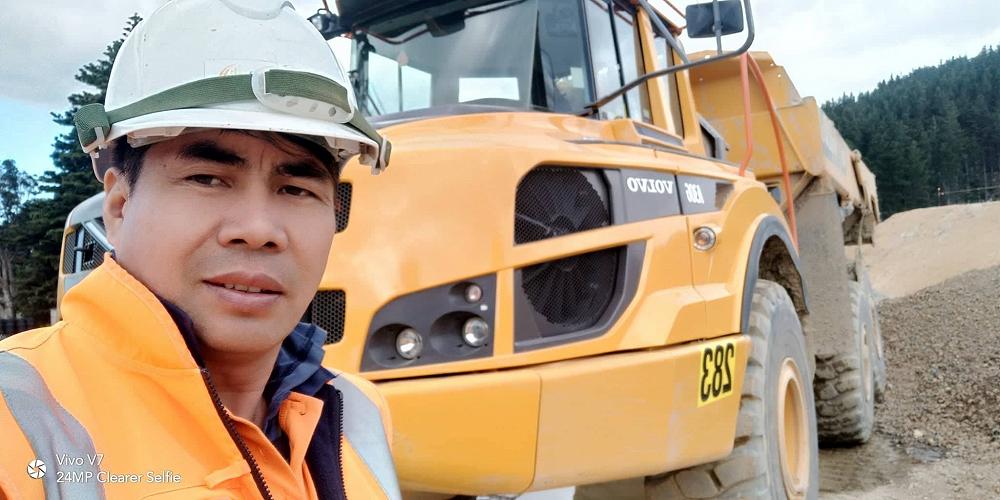
“I’m really glad that I can work here in New Zealand,” says Ranelio, a heavy machine operator for an Australian company on a roading project in Wellington. It was a Saturday evening and he had just arrived from work. “I do work on Saturdays, even on Sundays when the weather is good.”
“I have my qualifications in industrial technology, and have experienced working in Papua New Guinea for two years and in Saudi Arabia for three years. I felt I needed to work overseas, otherwise I would not be able to feed my four children, let alone send them to school.” Ranelio is an “OFW” — an overseas Filipino worker.
Working overseas due to the lack of domestic economic opportunities has been an ongoing phenomenon for many developing countries. For decades, the Philippine Government encouraged workers to find employment overseas. Training schools and programmes were established for healthcare, IT or construction workers, housekeepers, miners and many others. This phenomenon is an artificial solution that eases the huge problem of unemployment and at the same time generates income for the government from various processing fees and remittances — the money sent home by these workers to their families.
The remittances help improve the family’s quality of life with better opportunities. Children can go to school, houses are built, small businesses flourish. They sustain the economy and provide a sense of financial security. The total remittance sent by around 2.5 million OFWs from April to September 2017 was estimated at NZ$5.75 billion. But while remittances improve the quality of life for many Filipinos they are yet to make an impact on the overall inequality in the country.
A Form of Inequality
The Philippines is one of the countries in Southeast Asia where the gap between the rich and the poor is strikingly evident. While a small group of individuals or families has a monthly income of as much as PHP$7.8 million (NZ$227,000), eight out of 10 families survive on PHP$30,000 (NZ$870) or less. The daily minimum wage of PHP$512 (NZ$15) is not enough for a family with four children, like Ranelio’s, to live a decent life. An income of at least twice as much would only reach as far as providing for very basic needs.
“If I work in the Philippines, even with my experiences, it would be a hopeless struggle. What I would earn would barely meet our daily needs – not to mention providing for the children’s education,” Ranelio says.
Recent numbers show that more than a quarter of the population falls under the poverty bar — a situation which will only get worse as the population hits 142 million by 2045.
Inequality has many faces. In the Philippines, the inequality in basic resources takes the form of the inequitable distribution of economic opportunities caused by unemployment, the high inflation rate, decades of slow economic growth, recurring natural disasters and, above all, poor governance at the national and community levels. Government policies like the recently implemented Tax Reform for Acceleration and Inclusion (TRAIN) have meant further suffering for the poor while the rich continue to thrive. This form of inequality is extended to land distribution, basic welfare services, educational or vocational opportunities and human development. And 19 out of 20 people in poverty belong to households where the heads have little or no education, which limits their earning potential.
Widespread corruption in Philippine politics and business is also a major obstacle for growth and social mobility for the poor. Power is concentrated in a few families and closely connected individuals, meaning those without connections have little chance to improve their lives. It is this disconnect between policymakers and the people’s welfare that has a major impact on the poor.
Motivation
The glaring lack of opportunities, unemployment, low wages and deepening poverty in the country drive Filipinos to seek opportunities overseas despite known or unknown dangers. Overseas workers endure the psychological pain of being separated from their loved ones.
“While some of my mates would regularly come together for drinks to pass the time of being away from their families, what I do is to get involved in the Church and the community. It keeps me busy, makes me feel connected to my family. I feel [that] I need to be present to them even though I am here in New Zealand. I take the time to talk to them every night — to my wife and to each of my children. My children do have a mind of their own now, but they still need guidance and constant reminders,” Ranelio says.
He continues proudly: “My eldest child has recently completed a university degree, while the other one intends to become a priest and starts seminary training next school year.”
For most Filipino overseas workers, their children’s educational success is a major motivation to work hard. It is a fulfilment of their obligations as parents. It is worth all their sacrifices. Although there are also as many who are not as successful — with relationships and families permanently broken apart, or with personal purpose and meaning lost for all the sacrifices endured — working overseas remains a more attractive alternative than remaining in the home country.
Many overseas Filipino workers are professionally employed as accountants, IT specialists, engineers or nurses, but a huge number of them are in jobs that put them in precarious working and living conditions. Across the world, there are more women overseas Filipino workers than men. Most of these women are caregivers or domestic helpers who typically bear the brunt of the inequality that exists between migrant and domestic workers, employer and employee, homeowner and housekeepers — including the intrinsic unequal treatment for being a woman. Exposure to hostile working conditions and various forms of abuse or working for long hours are common. Anecdotal evidence and documented narratives of inequality for migrant workers also abound in New Zealand.
Some Implications
New Zealand will continue to rely on migrant workers from countries like the Philippines to fill workforce shortages across several sectors. It is important that their rights as migrant workers and individuals and their contributions to the society are recognised and protected. Conversations with the governments, agencies, employers and other stakeholders regarding consistency around policies, processes and interventions that affect migrant workers and their families need to be initiated and sustained. We can do this at the parish or community level, too, where support, assistance or advocacy on behalf of the migrants can be made available.
“I am a person who finds it difficult to say ‘No’. So, if I am asked to do a job even if it may be outside the normal arrangement, I will just do it. It is me, I hardly say ‘No’ to anybody, how much more to my employer,” Ranelio confides. Migrant workers concerned that their contracts and New Zealand work visas may not be renewed by their employers are vulnerable to injustice and inequality. They need to be encouraged to speak out about their concerns — and we need to listen to their voices. Understanding one another is a huge step towards equality.
Tui Motu magazine. Issue 232 November 2018: 10-11