I Am an Artist
NIKKI MARINER PESETA reflects on her journey to becoming an artist in Samoa.
I never planned to be an artist living in Samoa. Five years ago I was in Canberra at the Australian National University making headway in my doctoral research in Pacific history. In 2012 I fell madly in love with a Samoan artist, Lalovai Peseta, while we were both on a temporary work assignment in the Solomon Islands. This meeting changed my life.
The Journey
I’m the eldest of four sisters — the daughters of a Samoan father and Pākehā mother. They met while both studying nursing in Christchurch, New Zealand, and have been married now for 45 years. We moved around quite a bit as my father worked for the Seventh Day Adventist Church. I have many memories of sitting in the front row at church watching my father preach. My mother has an artistic leaning and introduced me to poetry, literature, music and the visual arts. She is the kind of mother who tells stories and encourages wide learning and experience.
At high school in Auckland I studied art for a couple of years and thoroughly enjoyed it. My marks weren’t bad either. But my social life and love life were my primary occupations.
Art re-entered my life years later when I was living in Queensland and hit rock bottom as an exhausted and depressed single mother of two beautiful boys. A friend arrived at my door with canvas, brushes and paint. She said: “Just paint!” — and I did.
Painting was my medicine. It soothed and comforted me. Painting freed me when I felt trapped. No one outside my family saw my artwork. As I got happier, I painted less. I got better, stopped painting and turned my attention to academia. History, Pacific history, literature and gender studies.
It was love that brought art back into my life. And love brought me to Samoa. It was an opportunity to live in my father’s homeland and understand my own cultural heritage better.
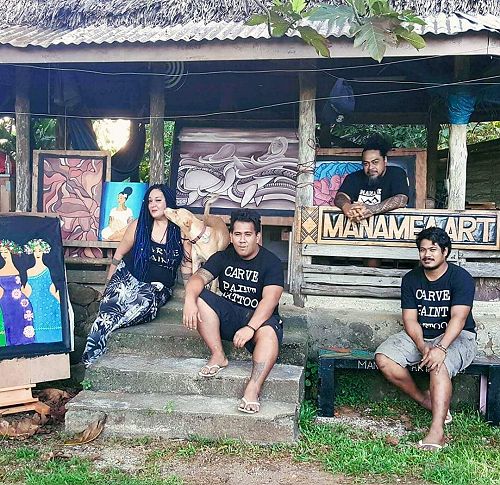
I married my Samoan artist 18 months after we met. We started a new life together and began our own art studio at the end of 2013 — Manamea Art Studio. We do custom designed carvings, tattoos and paintings.
Manamea is Samoan for sweetheart/darling/beloved. “Love and Art” is our studio motto.
Our Dream Takes Shape
I went directly from Canberra to Samoa — my first experience of living there. We set up in my mother-in-law’s backyard in the village of Avao on the island of Savaii. I was surprised to find a sense of tranquility I’d yearned for in our village life. No TV, limited internet and no car. My three suitcases of shoes, cosmetics, handbags and clothes quickly became redundant.
And the beginnings of our art adventure were also modest. Our studio was a small fale (traditional Samoan house without walls) surrounded by banana trees. Our customers occasionally paid for their tattoos with pigs. So the pigs lived under the fale and the chickens slept in the ceiling rafters at night. We set up a Facebook page on the smartphone as our “online shop”. Although we didn’t have much we upheld our principles of original artwork done exceptionally well and reliable, efficient customer service. To our delight and almost disbelief, the orders kept coming in and we began to grow.
Our Dream Surprises
After some time we moved to the main island of Upolu, rented a two-bedroom house in Vaitele Fou, got a puppy and named her Frida Kalo (slang for taro), and hired two full-time artists. It was hard work and we were constantly on the go — consultations, exhibitions, travel and rapid growth.
Then just three months ago we took a huge step in faith by signing a five-year lease for an old restaurant on the main road in Vaigaga and set it up as our Manamea Art Studio. The premises are big enough for all our art ventures and also to be able to host workshops and exhibitions. And we increased our staff — a third artist, an online reception staff member, an apprentice and a receptionist. We have renovations underway and we’re covering the walls with murals. We now export made-to-order carvings and paintings all around the world. I’m astonished by how fast we’ve grown and genuinely proud of what we are contributing to the arts and the economy in Samoa.
My Artist Emerges
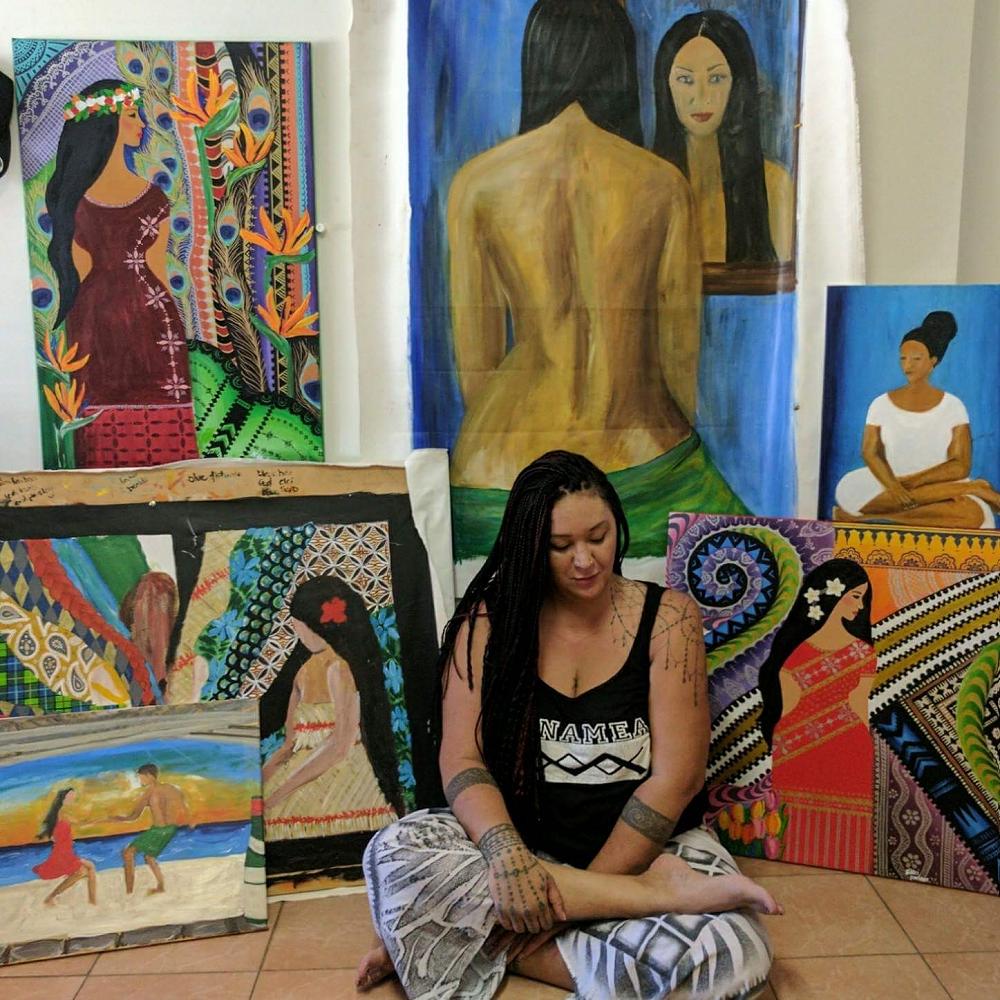
And this is how I came to be living in an art studio in Samoa. The studio is my art school. My gallery. My home. My collective. It is where I work and learn. I have no formal art training. My husband, a former art teacher, has taught me the most about techniques and theory.
In the early days I focused solely on building our art business since it was our only source of income. But as our team grew and took over some of those responsibilities, I was able to experiment with my own art practice, inspired by my experiences of living in Samoa. My paintings have sold internationally and can be found in Oman, Italy, Scotland, the United States, Australia, New Zealand and around the Pacific.
I painted a series about being married to a matai — a Samoan chief. When my husband received a matai title, I discovered that by default I would be known as his tausi — helper/support. A good tausi would not only support her husband in his responsibilities, but also exemplify virtues of Samoan womanhood such as modesty, humility and hospitality. These expectations were more than slightly daunting for someone like me raised outside Samoa — so I painted about them.
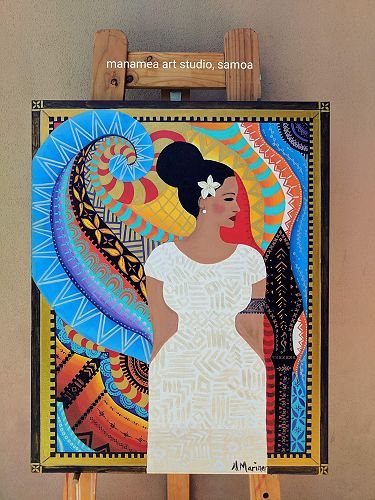
In my Tausi series, I painted female figures in a demure stance wearing white elei, as is the standard church outfit for Samoan women, with their long black hair rolled up in a bun. This represents the societal role of a tausi, the public face. But behind the figure, I used colours, shapes and patterns to represent internal conflicts and passions and emotions of these women as wives. These contrasting and dynamic elements depict the complexities of women’s private versus public life.
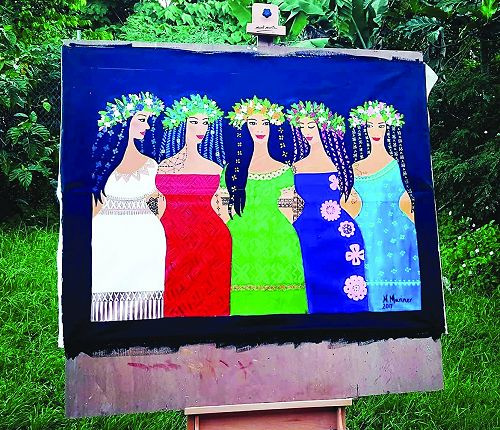
I’ve also explored the bonds between sisters, focusing on the interplay of facial expressions and eye contact. I’ve been playing with paintings of mermaids as a twist on a Samoan legend of Sina being pursued by an eel. These paintings are known informally as the “Sina’s Lovechild Series”.
Another collection is the “Suga Series” (suga is girl/female). These works are characterised by suga in bright Samoan puletasi outfits, flowers in their flowing hair, backgrounds of colour, motifs and textures — all saying something about the identity and personality of individual suga. I wanted to capture the diversity among women and girls in contrast to cultural uniformity.
I’ve found that there are very few professional women painters in Samoa, or indeed, in the world. While Island women have long been a favourite subject in art — muses for many and fodder for fantasy — their depiction as slim, scantily-clad women dancing on a beach or set against tropical scenery is misleading, unrealistic and involves a projection. I’m passionate about telling Island women’s stories from the inside, including the things that matter to us and the conflicts between cultural responsibilities and contemporary life we grapple with.
I’m determined to raise the profile of women in the arts in Samoa. I’m working to create opportunities for women painters to exhibit their work and nurture their talent. Next year we plan to host and curate an exhibition for Samoa-based women painters. It will be the first ever in Samoa.
This is my story of rediscovery, love, art and being a painter in Samoa.
Tui Motu Magazine. Issue 225, April 2018: 12-13
Gallery