
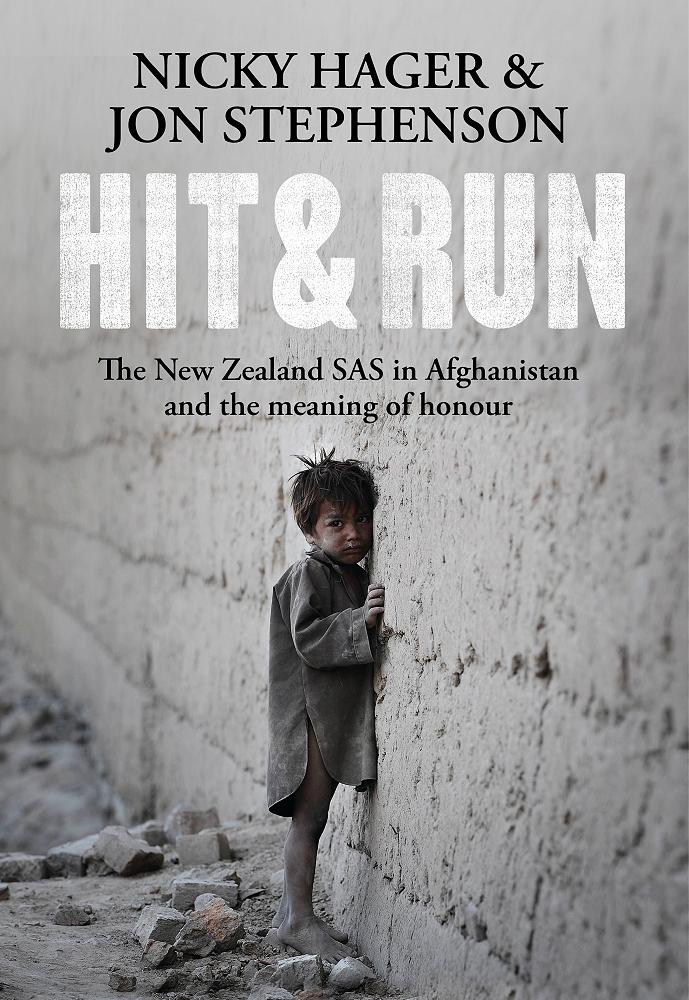
Hit & Run: The New Zealand SAS in Afghanistan and the Meaning of Honour
by Nicky Hager and Jon Stephenson. Published by Potton & Burton, 2017. Reviewed by Dennis Horton
If ever there were questions in the public interest that deserve an answer, they are the ones raised by this pair of investigative journalists — Nicky Hager focussing on sources at home and Jon Stephenson tracking down contacts in Afghanistan. In the Preface, the pair write that no one will read the book without wondering about war crimes.
They conclude “that there are reasonable grounds to suspect that New Zealanders and their United States allies were indeed involved in war crimes and other serious breaches of the laws of war. They call for an independent investigation. It is just such a process that Attorney-General David Parker has called for, in announcing in April that an inquiry will be led by Sir Geoffrey Palmer and Supreme Court Judge Sir Terence Arnold.
The events explored in this 160-page book followed the death of a New Zealand soldier in August 2010. Lieutenant Tim O’Donnell was killed in a roadside bomb attack when the patrol he was commanding came under fire from Taliban forces. The book argues that, in retaliation, the New Zealand Special Air Service led a raid on two isolated villages, in search of the fighters they suspected were responsible.
Those involved would have known the rules, which had been freshly issued by the US commander in Afghanistan, in a bid to reduce civilian deaths. Before firing weapons, “the commander approving the strike must determine that no civilians are present.” If there was uncertainty about whether civilians were present, firing was prohibited. “But it all went horribly wrong,” notes the back cover blurb.
“None of the fighters were found but, by the end of the raid, 21 civilians were dead or wounded. Most were children or women, including a three-year-old girl who was killed. A dozen houses had been burnt or blown up. The operation was personally approved by the prime minister via phone from New Zealand.”
A second raid was made, when more houses were extensively damaged, and a suspected insurgent was assaulted after capture, before being handed over to known torturers. “Afterwards no one took responsibility. The New Zealand military denied the facts and went to great lengths to cover things up. This book is the story of these events. It is, at heart, about the meaning of honour; about who we want to be and what we believe in as New Zealanders.”
Here is a book that needs to be read by anyone interested in exploring how New Zealand is involved in troublespots overseas, how and to whom its defence forces are accountable, and how well the population at large is kept informed about such involvement. We shall have to wait for the outcome of the Government’s inquiry to see how the questions raised in this book stand up, and to see how future episodes of this kind may be avoided.
Tui Motu Magazine. Issue 228, July 2018: 28.