
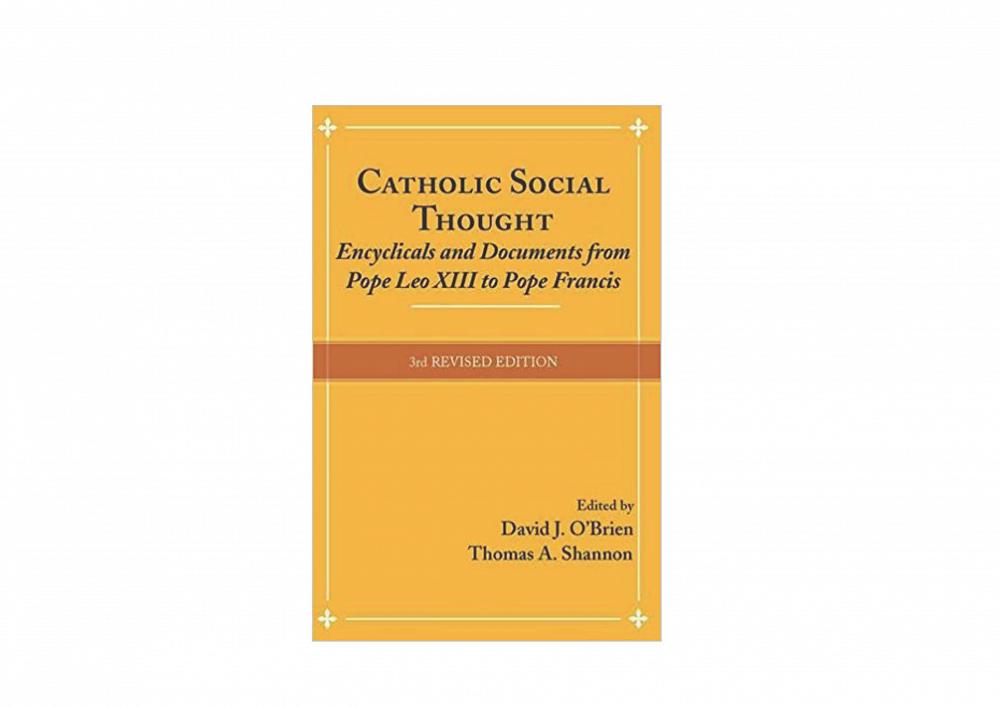
Catholic Social Thought: Encyclicals and Documents from Pope Leo XIII to Pope Francis (3rd Revised Edition)
Edited by David J. O’Brien and Thomas A. Shannon. Published by Orbis Books. Reviewed by Mark MacCallum
It’s a big book, almost 700 pages long. Essentially, it’s a reference book, a compendium of primary documents, organised chronologically and grouped by time period. Each of the 14 documents is accompanied by a brief introductory essay and referencing; and there are also brief introductory essays for the collection as a whole and for each time period (though these make up a very small part of the overall book).
All the significant papal documents on Catholic social thought from the modern era are here. And the documents in the book are entirely papal documents, apart from two: one issued by the Vatican Council II and the other by the 1971 Synod of Bishops.
This is the third edition of this work. The first was in 1992, the second in 2010. Now it’s updated to include Laudato Si’ (2015).
There’s a lot to admire in it. Catholic social thought is relevant and important and I wish the world knew more about it. And official Catholic social teaching (by the pope and bishops) is undeniably its centrepiece. And yet I suspect few general readers would benefit from acquiring this book.
First, while some of the material is not only informative but deeply inspiring, most of it, particularly in the earlier documents – let’s be honest – is not easy reading.
Second, if someone wants a general introduction to Catholic social thought – or even to study the subject to a reasonably in-depth stage – there are several accessible alternatives. One such source is the website of the US-based Jesuit Social Research Institute. This website sets out the relevant subject matter in a learner-friendly way and organises it by theme, quoting key passages from the primary documents. And it’s free. I strongly recommend it.
Third, for those who would benefit from reading the primary documents in their entirety (and there will be some), every document in the book can be accessed easily on the Internet, simply by entering the name of the document in a search engine. The interpretive text that O’Brien and Shannon provide does add some value, but maybe not all that much (it’s not particularly analytic, unfortunately).
For those who prefer reading a book to reading on a computer or device and want to make a study of Catholic social teachings or refer to a particular document, this would be a helpful reference book. And it is certainly a book to include in all libraries specialising in religion and theology. Regardless of the merits of this book for the general reader, I can certainly recommend the study of Catholic social thought!