
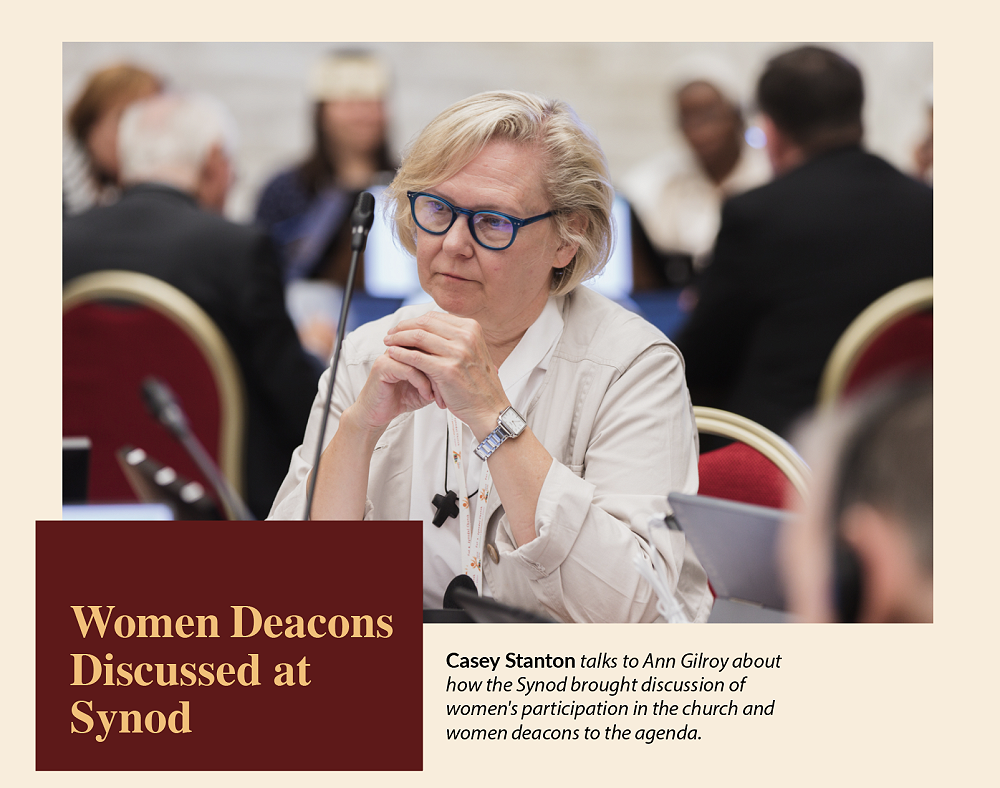
Women Deacons Discussed at Synod
Casey Stanton talks to Ann Gilroy about how the Synod brought discussion of women's participation in the church and women deacons to the agenda.
How has the synod handled the issue of women deacons?
"The synod gave space to begin to grow more of the conversation about the synodal nature of the diaconate, and to explore whether the Holy Spirit is calling women to this order of ministry (and calling the church to receive women in this order of ministry!)
"Cardinal Fernandez, prefect of the Dicastery for the Doctrine of the Faith, indicated that the question of women’s ordination to the diaconate was not yet mature enough for the Holy Father to be able to give an affirmative answer — but he underscored that the question was still open. This was ratified by the final document voted on by the Synod Assembly which states: “Additionally, the question of women’s access to diaconal ministry remains open. This discernment needs to continue” (par 60).
"While this phase of the synod is over, the process of becoming a synodal church is just beginning. And part of the next phase may call for a renewed vision for what a deacon is."
Could that vision include something other than a permanent diaconate?
"I think the question is about centring the needs of the poor, struggles for justice and dignity, and helping the message of the Gospel be alive in the realities of people’s everyday lives.
"The role of the deacon is as a bridge-builder, listening to the needs of the people of God and the broader community. I think that a synodal church needs tons of deacons! And I think that the Holy Spirit has been stirring a vision for this kind of diaconate in the hearts of many women and men throughout the world. A prophetic diaconate that is tuned into the needs — especially those who are often overlooked or feel they are forgotten, on the edges of our communities."
How long do you think it will take before we have an answer on the issue of women deacons?
"I think we’d have to ask the Holy Spirit that one … I do hope and trust that in the next phase of the discernment of this question there is room for those in the Vatican to hear from communities on the ground: from bishops who rely on women to exercise diaconal ministry in order to meet urgent pastoral needs.
"I know women today who would jump at the opportunity to discern a vocation to the diaconate with their local bishop as a way to strengthen their ministry and to honour the communities they serve."
How did the synod promote women and women’s participation?
"The synod process overall created unprecedented opportunities to hear directly from women around the world, who consistently expressed the urgent need to rethink women’s participation and discern concrete steps around expanding women’s leadership, exploring women’s ordination to the diaconate, and including women in decision-making.
"The synod’s final document is framed throughout by the collaboration and reciprocity of women and men in carrying out the primary proclamation of the church: that Christ has conquered death. It’s significant to begin the document with Mary Magdalene! Men and women have always been collaborators, both called by God to share in the mission of healing and proclaim good news. This is not a modern idea being imposed on the church from the outside — it's at the heart of the Gospel.
"The document also doesn't essentialise women, and I think that’s because of the participation of women in the process. It's the church that suffers when there are obstacles to women being able to fully realise their charisms. We’re not called to an idealised fantasy — we're called to be co-equal with men."
Would women deacons add another layer of clericalism?
"Pope Francis is trying to drive out the scourge of clericalism in the church and so I think he's hesitant at this moment to emphasise holy orders as the primary path of exercising discipleship today.
"And yet — I think opening up paths for women to exercise sacramental ministry would help lessen the distinctions between women and men in the life of the church, and the abuses of power that are at the root of clericalism."
In Aotearoa deacons tend to be retired men who have free time and can fund themselves. It makes it hard for a different person to take on that responsibility.
"I think this connects with the invitation to continue to renew and revision the diaconate so that younger men, including those with families, can feel encoaged to discern if they have a vocation — and especially, if their community is calling forth gifts for preaching and leadership that would traditionally be the charisms of a deacon.
"If a young man was 33 and felt that he was called to be a priest we wouldn't say: “Oh, no, let's wait till you're retired to start living your vocation.” But in many places today, that is the response that someone who is feeling a call to the diaconate might receive. This reinforces the notion that it is a role only for retired folks, rather than a vocation for the whole of a life.
"I really feel for clergy because I think our priests are stretched and we have people with gifts for ministry who could help sitting right in the front row of the church."
Tell us about your experience of the synod.
"My experience of the synodal journey is that it has drawn me closer to the heart of the Paschal mystery that is the heart of the church.
"Sometimes it’s frustrating — I want to see change here, in the land of the living. But the patient way, if it helps to build trust, consensus and deeper communion, feels worth going through the processes of discernment.
"It’s thrilling to realise that we really are protagonists, and that each one of us can contribute actively to living the church’s reality and mission in the world, right now, no more permission needed!"
Tui Motu Magazine. Issue 299 December 2024: 14-15