
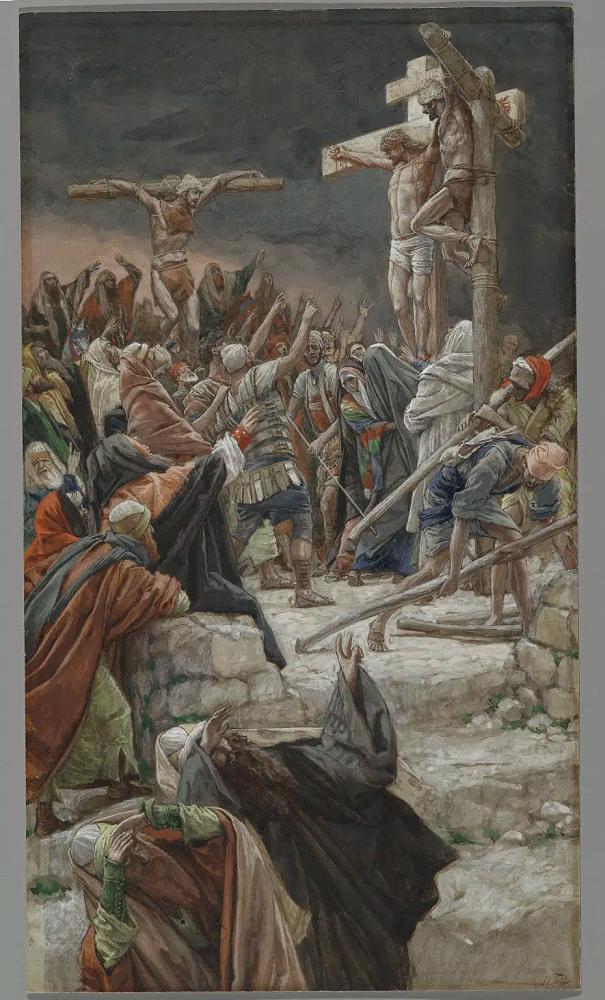
Jesus, Remember Me — Luke 23: 35-43
Kathleen Rushton explains how in Luke 23:35-43 Jesus’s ministry on the cross urges us to care for others even when we ourselves need care.
LUKE RECOUNTS THE horrible process of crucifixion in just a few words: “they crucified Jesus there” (Luke 23:33). Jesus was crucified with two criminals who are described as kakourgos — a word with an unambiguously criminal sense, meaning evildoer, criminal or malefactor. This word is used three times in Luke: when the two criminals are led away to be crucified (Lk 23:32); in the description of the crucifixion when the one on his right and the one of his left are named (Lk 23:33); and when one of the criminals derides Jesus (Lk 23:39).
Luke’s Reshapes the Execution Scene
In Mark’s Gospel, the execution scene is one of abandonment and rejection. But Luke reshapes the scene into one of hope and forgiveness. Luke adds Jesus’s prayer of forgiveness: “Father, forgive them, for they do know what they are doing” (Lk 23:34). While the people stood by watching, the religious leadership, the soldiers and one of the criminals mock Jesus with versions of: “If you’re the king of the Jews, why don’t you save yourself?”
In contrast, “the other” criminal (Lk 23:40) enters into a process of conversion. He owns his wrongdoing and acknowledges the justice of his punishment. His is the fourth acknowledgement of Jesus’s innocence (Lk 23:14,15,22).
Criminal Uses Jesus’s Name
“The other” says: “Jesus, remember me when you come into your kingdom.” The use of the personal name “Jesus”, which means “God saves”, is remarkable. This criminal is the first person with the confidence to address Jesus in this way — nowhere else in any Gospel does a person address Jesus simply as “Jesus”. Elsewhere, his name is accompanied by epithets suggesting reverence, for example, “Jesus, Son of the Most High God” (Mark 5:7; Lk 8:28) or “Jesus, Son of David” (Mk 10:47; Lk 18:38).
Biblical scholar Raymond Brown describes the wrongdoer as having “disciple-like spontaneity”. Disciples are distinguished by their willingness to accept Jesus’s invitation and to follow him spontaneously. The wrongdoer does not wait for an invitation. He anticipates the words of Jesus to disciples: “Ask and it will be given to you” (Lk 11:9).
“With Jesus”
Jesus’s dying companion asks to be remembered, but Jesus offers much more — he not only saves but offers intimacy by including him as a disciple. At the last supper, Jesus says to the twelve: “You are those who have stood with me in my trials.” Because of this, he promises that they shall eat and drink at his table in his kingdom (Lk 22:28-30).
“Truly” (Greek amen) gives solemnity to what follows: “I tell you today you will be with me in paradise” (Lk 23:43). Jesus promises the wrongdoer that he “will be with me.” That the wrongdoer will be with Jesus suggests he will share more than Jesus’s company in paradise. Like the twelve, he will share in Jesus’s resurrection. Nothing can separate Jesus’s dying companion from God’s loving mercy.
Salvation is to be “with Jesus” on his journey, his exodus to God (Lk 9:31). The criminal’s faith and conversion of heart prepare him for the journey. The kingdom of God is “in your midst” (Lk 17:21) and all who read this Gospel are invited to insert themselves into the story and make the same journey.
Urgency of “Today”
At the beginning of his public ministry, Jesus went into the synagogue of his hometown, Nazareth, and read from Isaiah: “The Spirit of God is upon me, who has appointed me to bring good news to the poor, who has sent me to proclaim release to the captives and recovery of sight to the blind, to let the oppressed go free …” (Lk 4:18). Jesus’s mission is summarised as preaching the good news of the kingdom of God (Lk 4:43). Now, as his death approaches, Jesus completes a final act of liberation to a poor one.
Jesus tells the criminal: “I tell you today you will be with me in paradise.” The focus is on right now, this very moment. Salvation is not in the remote future or even tomorrow but is in the present — “today” — and is based on a renewed relationship with God. “Today” is a special moment of discovery.
In a two-verse dialogue within Luke’s Gospel (23:42-43) we find the last words spoken by a human being to Jesus. These words of Jesus are his last to a human being in his pre-resurrection life. How we treasure the last words of ones we love.
Boundless Love and Mercy
If Luke is read from beginning to end, the reader discovers that “the kingdom (basileia) of God” is there about 38 times. Jesus proclaims the Kingdom of God as the unlimited, boundless love and mercy of God especially toward the despised and disenfranchised — the poor, women, sinners, Samaritans.
Luke’s “today you will be with me” gives us a sense of urgency to build this kingdom of God, regardless of our own circumstances. We are encouraged to grassroots action, to grapple with the problems that surround us. And we are reminded that we cannot ignore the pleas of others. Here in Aotearoa, as we struggle through a cost of living crisis, high unemployment and political division, we might think we’ve enough on our plate without worrying about problems beyond our shores. But Jesus has given us an example: himself on the cross, he continues to minister. He responds to the wrongdoer’s plea immediately, and with a promise of immediate relief: “Today you will be with me.”
Re-membering
To be “with Jesus” is to be in union, to be rightfully placed together. Mary Rose D’Angelo calls this “re-membering”. She says: “re-membering conveys together the ideas of bringing what has been hidden out of the shadows of history, of putting together what has been dismembered and of making someone a member of oneself, of a community or the tradition in a new way.”
Re-membering forces us to invite in those who are at the margins of our society. Aotearoa has one of the highest rates of imprisonment in the developed world. At her farewell, long-time Christchurch Women’s Prison chaplain Mary Kamo reminded us that we need to work at making our mainly middle class parishes an environment in which released prisoners who had discovered their faith in prison would feel welcome.
In Luke 23 we see Jesus on the cross. A repentant criminal asks Jesus to “remember” him. Jesus responds immediately, attending to the needs of the other despite his own suffering. There are lessons in this for us: in a country and a world which urgently needs our attention and our care, will we attend to the needs of others with urgency? Will we move towards action “today”?
Tui Motu Magazine. Issue 309 November 2025: 24-25