
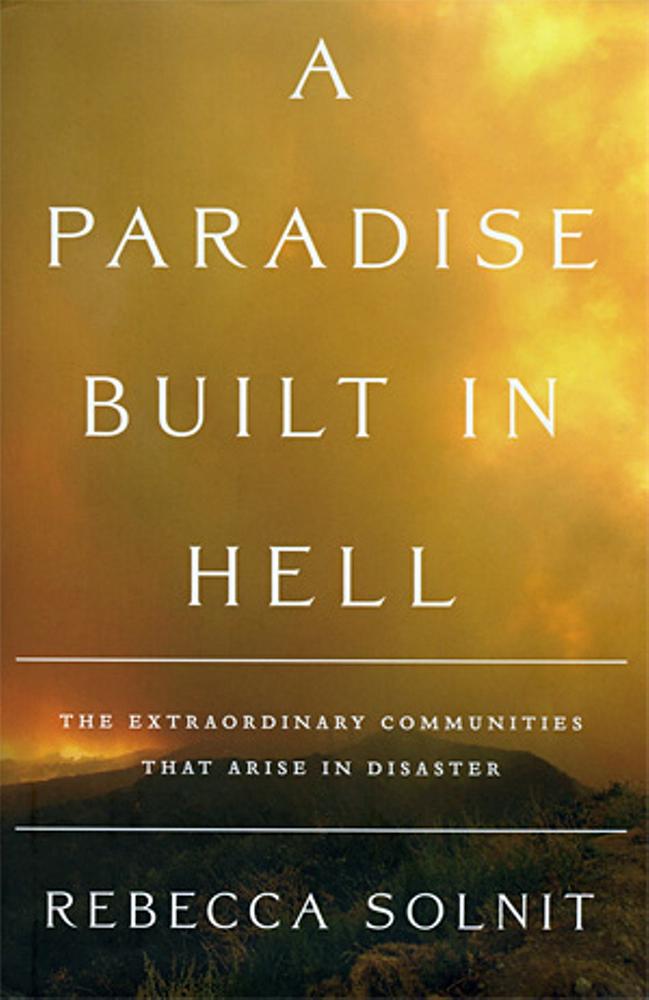
A Paradise Built in Hell: The Extraordinary Communities that Arise in Disaster
By Rebecca Solnit. Published by Penguin Books 2010. Reviewed by Paul Green
In A Paradise Built in Hell Solnit reviews and evaluates the overwhelming evidence of how communities of survivors have spontaneously created bonds of mutual support that cross religious, ethnic and class lines during disasters. The book is a selectively documented history of disasters that includes a full spectrum of survival communities, starting with the 1906 San Francisco earthquake and ranges across the WWII bombings of London and the short-lived New York response to 9/11.
It also details the more persistent development of survivor communities in Mexico City following the 1985 earthquake, which according to Solnit produced permanent changes in community self-governance in some. The depth and scope of her analysis depended on the availability of historical documents and research reports - many written by sociologists and anthropologists. It is enriched by her interviews with survivors of more recent disasters.
As a sociologist, I was aware of the central findings about the emergent mutual aid communities following disasters. Nonetheless the depth of Solnit’s findings were astounding. What I did not anticipate was the associated revelations concerning the incompetence of government officials, the outright obstruction of effective aid, the all too frequent repressive actions of national armies, elite panic about property loss, racial fear and violence against survivors and the willingness of the main-stream media to report rumours of rape, looting and murder by marauding survivors. These rumours were seen as credible and were thus too often acted upon in a way that diverted attention from the evacuation, aid delivery and rescue of stranded and injured survivors, causing still more suffering and death.
The media effectively reported what Solnit calls the "Hollywood" and "Hobbesian" versions of what happens in disasters like earthquakes, fires, floods, tsunamis and civil and international wars. It is the idea that in the absence of authoritative control we descend into an animalistic war of all against all, where the brutes terrorise the weak and helpless and the rest trample one another as they flee in panic. When the rumours were shown to be false, the retractions were sotto voce or not at all.
Hurricane Katrina striking New Orleans on August 29th, 2005 was possibly the worst case scenario and a travesty of all the possible negatives - official failures, abandonment, racism and armed repression that caused many unnecessary deaths. Yet there thousands of volunteers joined locals in solidarity to clean up and rebuild. The catastrophe destroyed much of the city and caused a diaspora of homeless citizens, many of whom never returned.
Equally important was the media failure to report on the amazingly effective survivor communities. Once formed their anarchic organisation, cooperation and absence of panic or distress was effective. Depending on a variety of factors these communities persisted for days, weeks or months until the authorities took over, often using force to restore order and often causing more grief. In New Orleans volunteer organisations found common ground and the cooperation lasted for years with many leaving and returning later.
Solnit’s idea of paradise is not an otherworldly heaven but an evolutionary product of survival that requires empathic individuals cooperatively sharing and sacrificing for their communities. These communities are based on empathy and compassion where renewed social bonds of generosity and solidarity are unrestricted by social divisions. She describes them as "paradise" or "utopia". They reminded me of Martin Luther King’s "Beloved Community" or St Augustine’s City of God.
Solnit praises Iceland’s and Cuba’s records for meeting disasters. Their governments effectively organised emergency systems for aid and evacuation and involved and empowered their citizens to be active participants in the processes.
In nations where the immigrants outnumber the indigenous people, Solnit suggests that unconditional societal renewals may take a little longer to build, especially in complex multi-cultural societies.
Her book challenges us to find ways of building community/government collaboration to effectively rebuild community participation and cooperation when disasters happen. That requires practising generosity and solidarity across social divisions now.
At 350 pages A Paradise Built in Hell is a very readable page-turner and I recommend it highly.