
The Spiritual Impact of Sexual Abuses
ROCÍO FIGUEROA ALVEAR and DAVID TOMBS report on how sexual abuse was disclosed and is being handled in a Society of Apostolic Life in Peru.
Church sexual abuse crimes, and the institutional cover-ups that often accompany them, have been widely reported in Canada, the United States, Ireland, the United Kingdom, Belgium, the Netherlands, Germany, Australia and elsewhere. Until recently Latin America has received relatively little international publicity, but this is now changing. A number of lay movements and Catholic communities have faced allegations and their leaders have been publicly denounced.
Three cases have received particular attention: the Legionaries of Christ in Mexico, the Karadima group in Chile, and Sodalitium Christianae Vitae in Peru. These three communities are part of the birth and growth of new movements that occurred in Latin America following Vatican II. Each of these three new movements was initially heralded for its success and growth in attracting new members, and yet the founder of each has subsequently been accused of serious sexual abuses. While all the members of the Legionaries of Christ and Karadima community are priests, the members of Sodalitium Christianae Vitae (henceforth known as Sodalicio) are mostly lay Catholics, and the founder is a layperson, which makes it particularly noteworthy.
Foundation of Sodalicio
Luis Fernando Figari, founded Sodalicio in 1971 as a Society of Apostolic Life within the Catholic Church. Sodalicio has a presence in schools and churches, and runs retreat facilities and Youth Centres with communities in Peru, Argentina, Colombia, Brazil, Chile, Ecuador, Italy and the United States. Although the members are mostly lay Catholics the Society also includes clergy.
Abuse Disclosed
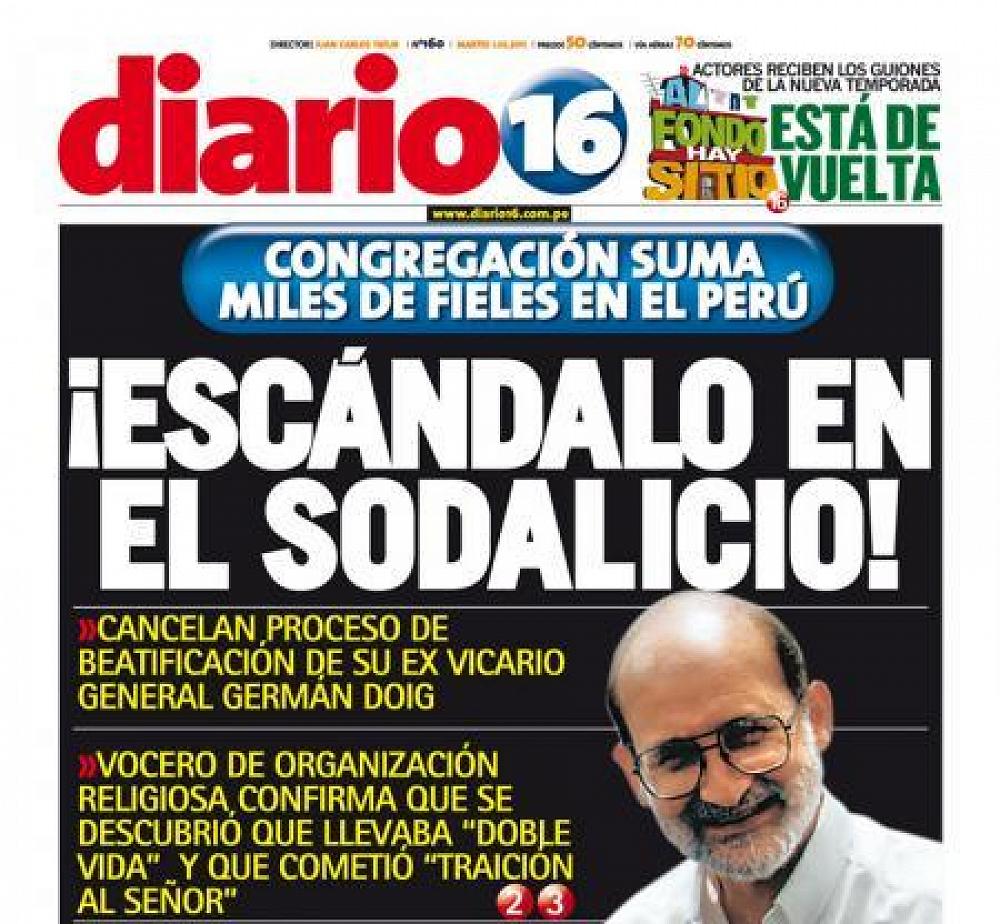
In 2010 the journalist Pedro Salinas, a former Sodalicio member, accused Figari of physical, psychological and sexual abuse. In late 2010, Figari resigned as superior of Sodalicio “for health reasons” and was sent to Rome. This was the same year that the cause of beatification of Germán Doig, Vicar General and number two within the organisation, was suspended. Doig himself had died in 2001.
The following year, the Peruvian newspaper Diario 16 published testimonies of sexual abuse accusing Germán Doig. Despite these allegations in February 2011, Sodalicio took years before they offered reasonable support to the victims, and this was only initiated after strong criticism of Sodalicio in the press.
In October 2015, Salinas published the book Mitad Monjes, Mitad soldados. Lo que el Sodalicio no Quiere que Sepas (Half Soldiers, Half Monks: What the Fellowship Does Not Want You to Know), which he had written with the journalist Paola Ugaz. The book gathers 30 testimonies of abuse committed by the founder, Luis Fernando Figari, and other leaders of the organisation over an almost 30-year period. Of these testimonies, five narrate episodes of sexual abuse and three accuse the founder Figari as the perpetrator. According to his book, three men lodged complaints in 2011 with the Peruvian Church Tribunal alleging Figari sexually abused them when they were minors. The three presented their cases to the Vatican and the Court of Lima in 2011, but were still waiting for a response.
Sodalicio Response
In response to the book, Sodalicio announced that the Vatican had launched an investigation into Figari six months earlier in April 2015 and admitted that the sexual abuse allegations against its founder and other senior members were “plausible”.
In an online video Sodalicio’s current leader, Alessandro Moroni, apologised to victims acknowledging that they had “received no satisfactory reply” from the group for years and declared that they considered Figari guilty of the allegations of abuse against him and therefore a persona non grata in the Society.
At this point Sodalicio hired experts to offer psychological assistance to victims and initiate a review. It appointed a special commission that included lawyers, a psychiatrist and a Peruvian bishop. They interviewed more than 50 former members of Sodalicio who denounced physical, psychological and sexual abuse. On the 16th April 2016 the Commission published a ten-page report in which they explained the abuses and the factors that enabled the sexual abuse within Sodalicio.
Report Findings
The Commission affirms that “the damage was perpetrated in a situation in which the superiors assumed a 'dominant position' asking for perfect and absolute obedience achieved by the practice of extreme discipline. ... This way of exercising power was an attempt to destroy their individual will”. Although there were complaints and denunciations, says the report, the leaders failed to act, covering up the abuses in a “complicit silence” over many years.
Because the abuse was perpetrated over 25 years ago, the statute of limitations makes it impossible for Figari to be prosecuted by civil authorities today. Meanwhile the Vatican investigation of Figari is still ongoing.
Tasks Now Necessary
At least six interrelated tasks are necessary in the aftermath of cases of this sort. They include: investigating what happened to establish the truth about both the original events and any subsequent cover-up; an acknowledgement of institutional failings and individual misdeeds; holding perpetrators to account in law for any crimes committed; establishing new structures and policies that make future abuses more difficult; attention to reparations; the offer of effective psychological support and pastoral care for survivors.
To help inform this sixth task, the Centre for Theology and Public Issues at the University of Otago has just published a report drawing on interviews with eight survivors from the Sodalicio case. The interviewees are now all middle-aged but had been involved with Sodalicio when they were younger. Many, but not all, of the interviewees had featured in the Salinas book. The new interviews provided the opportunity to explore the psychological impact of the abuse further and investigate the consequences for their sense of faith and their relationship with God.
As one of the authors, Dr Figueroa, has a particularly close knowledge of the case and many of those involved. She was previously a member of the Marian Community of Reconciliation (MCR), a Catholic Association of lay consecrated women, which is the female branch of Sodalicio. Figueroa served as the MCR General Superior for 9 years (1991-1998). Since 2006 various male victims from Sodalicio have contacted her to denounce sexual abuse perpetrated by members of Sodalicio.
In 2006 she began an investigation that continued over a six-year period and during this time she found more victims. She helped these victims to present accusations against the founder, Luis Fernando Figari, to the ecclesiastical court in Lima and also to the Vatican in 2011. During this time Dr. Figueroa developed a relationship of trust with the victims and this was a crucial factor in making the interviews possible. What they have disclosed needs to be known more widely within the churches.
Abuse Impacts on Person’s Spirit
One described the impact as “catastrophic”. When he was asked about his faith in God he answered: “It gives me too much pain and sadness to feel that he abandoned me and just to ponder the possibility that he failed me is unbearable.”
In cases where participants did not consider themselves religious the spiritual impact was less dramatic and primarily served to confirm their aversion to religion. One of the interviewees affirmed: “I am not religious because of the abuse. And not only because of the abuse but also because of the cover-up and the corruption of the Church. It has had a huge impact on my religious life.”
Revelations of the prevalence of sexual abuses in a wide range of institutional contexts, both Church and secular, are continuing to emerge. However, the spiritual impacts of sexual abuse are a largely neglected topic. This neglect ignores the way that physical, psychological and spiritual impacts often occur together and can magnify one another. One lesson from this report is that the spiritual impact of abuse should be included in any full understanding of impact and consequences. This appreciation is particularly relevant in instances of church-related sexual abuse but also extends to all forms of sexual abuse. This is especially important when survivors have a strong sense of personal faith and/or communal religious identity.
Note: In January 2017 Sodalicio offered over $2 million to 66 victims for counselling and getting into work.
The Superior General said: “For us, the main responsibility lies not with the Vatican, nor with the Public Ministry. The primary responsibiltiy for repairing the damage is ours.”
However, the General Attorney in Peru has halted the investigation in the case which created a public furore and press coverage.
Read Report: Listening to Male Survivors of Church Sexual Abuse. Voices from Survivors of Sodalicio Abuses in Peru
Also in Spanish
By Dr Rocio Figueroa Alvear and Professor David Tombs
Published in Tui Motu Magazine Issue 212 February 2017:12-13