
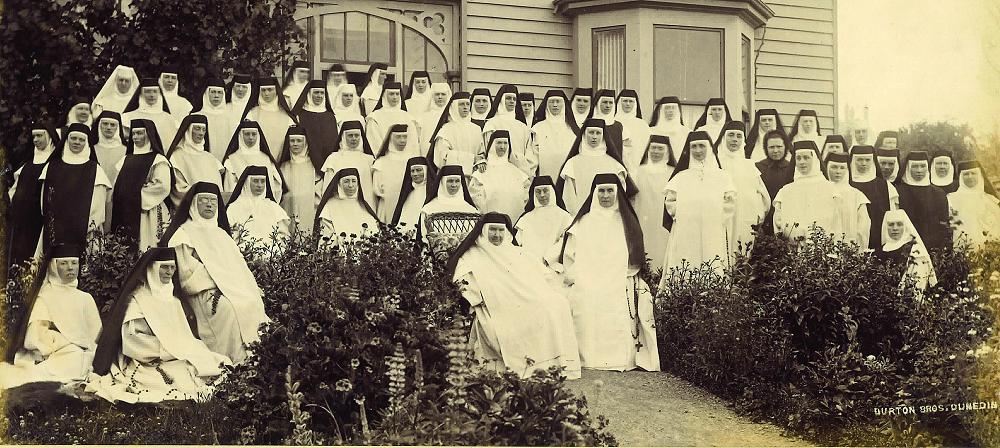
God's Work Awaits in Otago
Elizabeth Mackie tells the story of the first Dominican Sisters to come from Ireland to New Zealand and their legacy 150 years later.
It is now 150 years since the first Dominican Sisters arrived from Dublin to begin Catholic education work in Dunedin, New Zealand. In Toitū Otago Settlers Museum there is a realistic installation of a cabin typical of those on sailing vessels which brought early settlers to Otago from around the world. Each time I see the cabin’s confined space and stark furnishing, I marvel that the first 10 Sisters from Sion Hill Priory in Dublin, lived in such confined quarters during their four-month journey from Gravesend, England to Port Chalmers. They came by sailing vessel, because a steamship passage was too expensive for them. Undoubtedly they were crowded and uncomfortable, yet their records of the journey mention nothing of this. They write of the regular rhythm of prayer they arranged for themselves, their study of Italian (the more advanced students among them read Dante!), the social activities on board and their wonder at each new experience.
Dublin Priory Sends Sisters to South Africa
The Sisters missioned to New Zealand were not the first group to leave the Sion Hill Priory for distant countries. The Sion Hill convent was established in Dublin, first in Mount Street and then moved to St Mary’s parish in Booterstown in 1840. Eight years later the newly ordained Patrick Moran was appointed to Booterstown and there came to know the Sisters and their educational work. When he became the Bishop in the Cape of Good Hope, South Africa, he asked the Sion Hill Priory to send Sisters. Sisters set out for Africa in 1867 and soon after opened schools in Port Elizabeth.
Priory Sends Sisters to Aotearoa
Just three years later, Pope Pius IX created the new diocese of Otago, Southland and Stewart Island in New Zealand and he appointed Bishop Moran as its first bishop. Moran went back to Sion Hill to seek Sisters for his new diocese. Although their numbers had been depleted by the African mission, the whole community voted in favour of the Aotearoa mission. Ten Sisters were chosen from those who had volunteered and they accompanied Bishop Moran to New Zealand.
The records of the time describe them as “some of the brightest stars in Sion’s firmament”. They were well-educated, talented women. The oldest was 59 and the youngest just 19. The Prioress of the new venture, Mother Gabriel Gill, was 33. They left Dublin on 5 October 1870, sailed first to Gravesend and then boarded the Glendower to travel round the Cape of Good Hope and arrive in Sydney on 2 February 1871.
During their few days in Australia they were “courted” by the Sydney bishop, who wanted to divert them from New Zealand to schools in his diocese. He showed them several fine locations for convents and schools and insisted their standard of education was excessive for the residents of Dunedin! But the Sisters, remaining loyal to their purpose and Moran, continued on and arrived in Port Chalmers on 18 February 1871 — 150 years ago this year.
Getting Established
The newly arrived Sisters faced the hardships and privations involved in settling into a new land, a new diocese with limited finances and a new society. Many of the settlers were also Irish Catholics who had migrated to Otago after gold was discovered in 1861. The Church in the diocese was under the care of French Marist priest, Delphin Moreau. He had organised a welcome and had furnished a seven-bedroom house for the Bishop. Through miscommunication he thought that just one Sister was coming with Moran. Faced with 10, he offered to get the disused hotel, the “Robin Hood”, further up the hill for them. Instead, the Bishop gave his house to the Sisters and rented a small cottage nearby for himself.
However, within days he called on Mother Gabriel with a sheaf of bills for all the furniture and fittings (“mirrors in every room”) for the house, which he had no way of paying. She cheerfully took the bills, sent back all but the most basic furniture, and paid for the rest from their first school fees.
The Sisters’ energy was breathtaking. Two days after arriving they took over the existing school and a week later they opened a small high school for girls. They offered after-school classes in piano, singing, the harp, wax flower making, painting, needlework and European languages. The income from these classes provided for their keep. They began fundraising with bazaars, raffles and variety concerts at which their pupils performed. So successful were they that six years later, they were able to move into the newly built main wing of St Dominic’s Priory. Later other buildings were added, including a novitiate, boarding school and classrooms. The first New Zealand novice was professed in 1878 and a steady stream of other young women joined the Congregation through the years.
Sisters Spread Further from Dunedin
From their base in Dunedin, the Sisters moved into the main centres and the goldfields of Otago and Southland. By 1900 they had established schools and convents in Invercargill, Oamaru, Queenstown, Milton, Lawrence, North East Valley (Dunedin) and Cromwell. In the 20th century they continued to send Sisters within Otago and into the Auckland and Wellington dioceses. They established the only New Zealand Catholic school for Deaf children in Island Bay. And for a short period in the 1980s the Sisters lived and taught in a mission station in Vanuatu.
Aotearoa Sisters Send Sisters to Western Australia
Mother Gabriel, whose energy, vision, planning ability and commitment to the Church’s part in mission were such a driving force at the beginning of Dominican life in Dunedin, was seldom daunted. In 1899 Bishop Kelly of the new Diocese of Geraldton (West Australia) asked the New Zealand Dominicans to make a foundation in that diocese. So Mother Gabriel, along with another of the first Sisters (foundresses) and four other Sisters, volunteered to go. They left New Zealand in April 1899, and Gabriel never returned. She celebrated her golden jubilee of profession in 1904 in Cue on the Murchison Gold Fields. The next year she died quite suddenly on Holy Saturday in a small two-roomed convent in Day Dawn.
Sisters Have Grateful Hearts Today
It’s 150 years since the Sisters arrived in Dunedin. Today we are a small Congregation of Dominican women. Although we are autonomous, we are part of the worldwide Dominican Family and retain strong links to the Irish Dominican Sisters, whose missionary generosity started our New Zealand Congregation. We are rooted in this land as Nga Whaea Arahi Rongopai O Aotearoa. We belong to the Oceania Federation of Dominican Sisters and are founding members of Dominican Sisters International, which connects Dominican women around the world.
Even while we celebrate our 150 years in Aotearoa, the worldwide Order is remembering the 800th year since the death of St Dominic. Our hearts are overflowing with gratitude as we recall our origins and our heritage. We give thanks for our 10 intrepid foundresses and all that they brought with them. We are grateful for the early Catholic people who supported the Sisters generously. We give thanks for all our students and their families through 150 years for all that we learned from them and for their loyalty to us. And we are grateful for all our Sisters over 150 years and for all the women and men with whom and for whom we have ministered. For all this and much more we wholeheartedly sing: “Alleluia!”
Tui Motu Magazine. Issue 258 April 2021: 18-19