
Responding to the Call
KEVIN TOOMEY tells of his early connections with Tui Motu magazine and the way he developed the magazine in his term as the second editor.
Tui Motu magazine grew out of a chance conversation in Rome. That was a breath of the Holy Spirit, for it was impossible to have guessed then what it would become 20 years later — the only religious magazine of its type currently published in Australasia.
I was sitting in my office at Santa Sabina Convent in Rome the morning I received a letter and magazine from my sister, Maura. It contained the final edition of the New Zealand Tablet, which had been published continuously since 1873. I was feeling sad. It had been an initiative of the first Bishop of Dunedin, Bishop Patrick Moran, a great friend of the first Dominican Sisters. Moran wanted to keep open the Catholic side of a raging debate about “free, secular and compulsory” education and to put a coherent Catholic viewpoint to his people and New Zealand society. Since then the Tablet had had interesting moments with Father James Kelly’s seditious Irish invective, and John Kennedy’s hardening attitude to Vatican Council II.
At this point, Fr Timothy Radcliffe, the Master of the Order, walked into my room. I told him this story in short form. His reaction was immediate: “Why don’t the Dominicans do something to fill the void? After all, it is a traditional ministry for us.” Later that day I faxed that idea to Sr Judith McGinley in Dunedin. The Sisters’ Leadership Team — Judith was then prioress — was meeting. The Team caught the idea and immediately began to investigate further. The magazine had begun.
First Acknowledgements
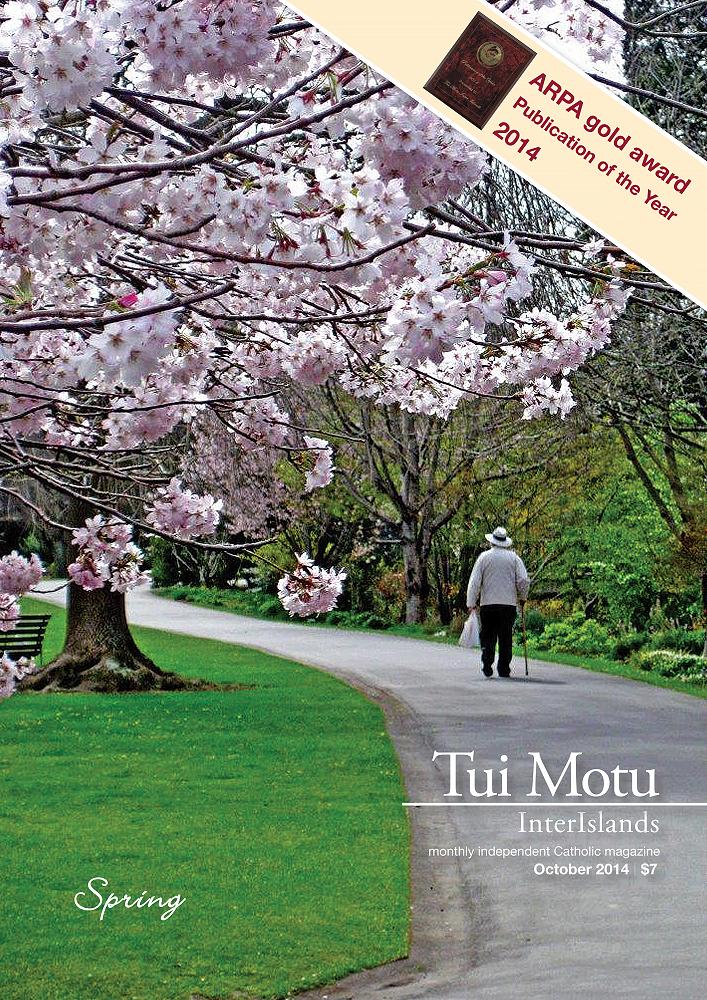
When the first issues of Tui Motu were published I was still living in Rome. My sister, Maura, gifted me a “sub” and I enjoyed watching this “little flower” bloom and grow. Michael Hill asked me to be the magazine’s “Roman correspondent” but my work precluded that: I was away from Rome six months of each year. When Austin Flannery OP, the longtime editor of the Dublin journal, Doctrine and Life, asked to see this Dominican-inspired magazine from the Antipodes, I obliged, and — quite unexpectedly — he handwrote comments which I enthusiastically passed on to Michael Hill and Francie Skelton. Austin was impressed by the breadth of the material, layout and imagery. He was taken by the original covers, as well as the many sketches or vignettes which accompanied the stories and gave a distinctive character to the look of the magazine.
Introducing Original Art
I must credit Donald Moorhead for this visual component of the developing magazine. Donald lived in North East Valley, close to the Rosminians, was a well-known piano teacher and had developed his own successful style of visual art. The punt to employ Donald was a sign of the maturity of vision which Michael and Francie had for the magazine. Over the years Donald’s covers won prizes at the Australasian Religious Press Association and Australasian Catholic Press Association awards — against strong competition from Australasian religious publications.
Professional Design and Layout
Greg Hings was also crucial to the development of the magazine. When I took over as editor from Michael in 2010, Francie stayed on for some months to ensure continuity and no loss of institutional memory. My skills in layout and design were zilch and I concluded very quickly that I could not do what Francie did so easily. I could see the structure of the magazine in three parts: editorial, design and layout, and production and publication. So we employed Greg Hings for design and layout. Like Donald, Greg was an inspired choice — a dream to work with, who never interfered in editorial policy or decision making and who often found material which complemented the writing and pushed the thought behind the article in ways that added richness and inner strength.
The Second Editor
But I have got ahead of myself. Years before 2010, it was clear that Francie and Michael would soon retire. Names were bandied about, my own included. I discounted that possibility, having absolutely no experience of publishing. But late in 2009, at a meeting of Dominican Sisters and Friars, someone began to speak very directly about the fact that I should be the next editor of Tui Motu. Not only that, but every other person in the room echoed these sentiments. I felt as though I was slowly being nailed to the wall! By the end of that meeting, I had agreed that I would ask what my community and provincial thought of this ludicrous idea. If amenable, I would think further. To my surprise, both gave the nod. The rest is history. As a complement to my appointment, it was agreed that Elizabeth Mackie and I would work together as the editorial team. Elizabeth had helped get the magazine going, and had been on the Board ever since, sometimes as Chair of that august body! There was no better person to join me.
Working Together
From the beginning we had a determined way of working together. Each month, we took a morning to sit and chew the cud — a kind of contemplative time. We asked what matters most right now, in the Church, in wider Aotearoa and world circles; what cannot be overlooked; what underlying questions need teasing out. We prioritised searching for ecological and interfaith material. It was Elizabeth’s gift to see deeply, allowing us to attack a topic differently.
We then searched for writers with expertise of the chosen focus: usually we asked three people to write the major challenge of that issue from diverse lenses. We sought complementary material. We always had a centrespread — with photos, poetry or a Donald Moorhead take. The most successful centrespread was a group of photos of new galaxies taken from the NASA website. It was reproduced many times. We searched out new writers and encouraged others to continue to write. There were excellent columnists, each with a different viewpoint.
Focusing the Content
Reflecting back, “open”, “edgy”, “provocative”, “trying to take an issue forward” described much of what was produced. We deliberately addressed difficult topics, but hoping to invite a reasoned and forthright response, founded in the gospel, grounded in social justice, ecumenical and inter-faith oriented, and faithful to Catholic Church teaching but unafraid of constructive criticism. Occasionally, we had serious repercussions from published material, usually around sexual abuse matters. Dealing with these was an on-going and sometimes rigorous exercise requiring help from other professionals. Mostly, a good solution was found.
Tui Motu Community
Elizabeth and I inherited a community of readers and friends from Michael and Francie, who are vital to the Tui Motu enterprise. Often questions arose from subscribers — some arose from the articles, others from the simple need to talk. The sympathetic listening to questions, or the joys and sorrows of life, was an integral part of the magazine’s open, pastoral and caring stance. Tui Motu continues to be a non-parochial, ecumenical community with some 2,000 participants. This undoubtedly has given the magazine its distinctive flavour.
Passing the Baton Again
During my five very full years as editor I could see the challenge to move the magazine into an IT-friendly environment, using Facebook and digital media — aiming to reach a wider and younger audience. Now, some years away from the editorial helm, I can see that Ann is developing some of these areas. Kudos to you, Ann, in this next stage of the magazine’s history. As my father used to say: “Per ardua ad astra. (Through adversity to the stars.)” May Tui Motu flourish!
Tui Motu Magazine. Issue 219 September 2017: 8-9.