
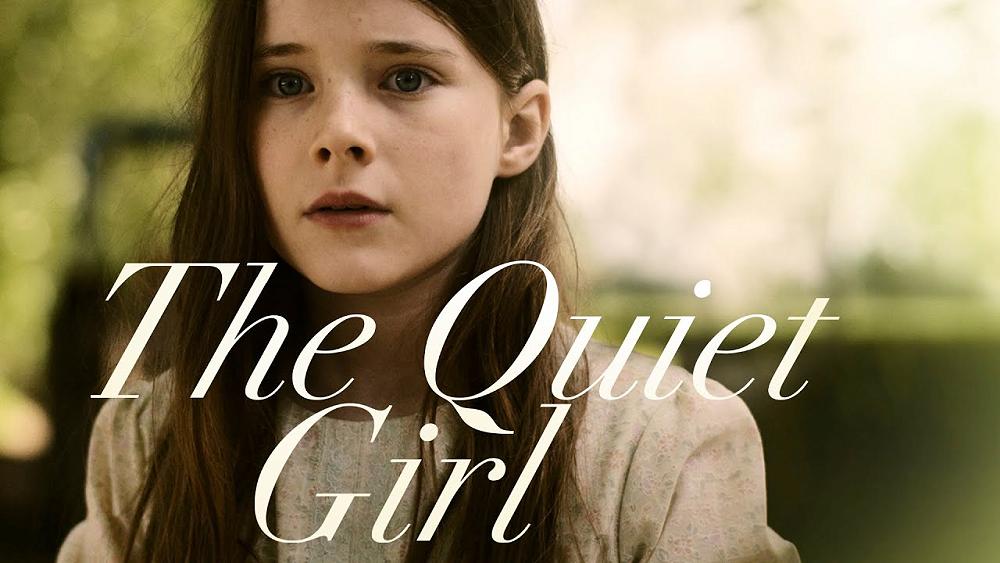
The Quiet Girl
Directed by Colm Bairéad. Reviewed by Paul Sorrell
What do we owe our children? What does a child need to thrive? These and many other questions are raised in this meticulously crafted Irish film that is relentlessy clear-eyed and unsentimental in its approach to issues that concern us all. Based on the novella Foster by Claire Keegan, the film is notable for its Irish Gaelic dialogue, although the characters slip into English readily enough when the need arises.
Cáit — the quiet girl of the title — is living with a clutch of sisters (I was never sure quite how many) in a rundown farmouse in rural Ireland in 1981. Her mother is at the end of her tether — harrassed, exhausted, resentful of her feckless husband who is drinking, smoking and gambling the family’s money away. A negligent husband and father, the only thing he is good at is producing ever more children.
With another one on the way, Cáit is sent off to spend a few weeks with her mother’s cousin Eibhlín and her husband Séan. While Eibhlín welcomes her new charge with open arms, at first Séan is distant, even resentful. Yet this dairy farming couple is in many ways the opposite of Cáit’s birth family: conscientious and houseproud, and involved in their local community, as we see in scenes ranging from a friendly card game in their kitchen to a wake held for a neighbouring farmer whom they had gone out of their way to help.
Yet this family, too, is nurturing a deep sadness. When Eibhlín asks Cáit if she’d like to go with her to the well on the farm property, Cáit asks, disturbingly, if this is something that she’ll have to keep a secret. “There are no secrets in this house,” answers Eibhlín — words that will come back to haunt her, and us as well.
Shot in an unusual square format, the film unfolds in a series of short scenes or vignettes. Like Cáit, encountering her changing — and often baffling — world, we are asked to create the connections between them for ourselves. Hoarding her words, painfully shy and introverted, yet possessed of an almost luminous poise, the figure of Cáit stands at the heart of this profoundly moving and unsettling Irish drama. Despite — or more likely because of — the utterly devastating final scene (this is not a film for those who demand happy endings), The Quiet Girl will stay with me for a long time to come.
Tui Motu Magazine. Issue 275 October 2022: 28