
Connecting in a Prayer Community
Shanti Mathias talks to the creative manager of the prayer app Pray As You Go about using technology for prayer.
Emma Holland is on the other side of the ocean, but I feel like I’ve met her before. I have, in a way: we’ve been praying together for years. Holland is the creative manager of Pray As You Go — a daily prayer podcast produced since 2006 by the Jesuits in the UK. It’s morning where she is in a brightly lit room with the logo of her podcast on the wall behind her. In Auckland, it’s a warm summer night and I’m listening to Emma on an audio signal converted to ones and zeros, ricocheting under the ocean from London to Aotearoa.
The question of the technology that connects Holland and me is material to her work. Pray As You Go could be seen as a contradiction: it tries to bring the silence and wholeness characteristic of Ignatian spirituality onto people’s phones — places that are more often home to noise and distraction.
I’ve been using Pray As You Go for years, and I’ve certainly experienced this dissonance. I speed up most of my podcasts so I can get the information faster, but when I push play on a Pray as You Go episode, I slow it down because information transfer is not the point. I get distracted easily on technology apps and find myself sending pictures of trees to my boyfriend, or replying to messages from a friend, but Pray As You Go captures me in prayer.
Digital Space for Prayer
“We make decisions based on what is going to distract people the least,” Holland says. There are no ads interrupting the prayer. There are no subscriptions. The app doesn’t have hundreds of notifications a day or a busy design. It seeks to translate into digital form the ancient prayer practice of Lectio Divina. It provides space for journalling and hearing the Gospel passage of the day from the liturgical calendar.
Pray As You Go is different from a news app sending constant notifications of what is happening. “Scripts are written months in advance,” Holland says. They’re created by a team of spiritual directors and lay Jesuits, many of whom are women. Each episode has a song, a reading of the Gospel passage for the day, questions for reflection, a prompt for praying and ends with the traditional doxology “Glory be to the Father…” Sessions don’t instantly respond to current events, but God still speaks.
“It’s amazing to watch how it lines up with current events so often,” Holland says. In the middle of the Covid pandemic and the Black Lives Matter protests, Pray As You Go released an episode that invited listeners to pray for people who couldn’t breathe. At that time people were reacting to awful events — chanting on streets, protesting. “[The writer] didn’t know that this would be happening when we recorded it,” Holland says. “It just came up at the right time, and that is a God thing.”
It’s tempting to see technology as nothing to do with God. Certainly, the devices we use in order to listen to Pray As You Go are known to cause heartache — made of materials mined in unsafe labour conditions, manufactured in factories contributing to air pollution and enriching some of the world’s biggest and most ruthless corporations. While this is true, it doesn’t take away from the reality of prayer as something that can be embedded. Holland prays as she mixes audio files on her computer. Narrators and writers pray as they record new episodes. Musicians pray as they compose new melodies to direct attention towards God.
Digital Prayer Can Be Embodied
“We don’t want to commodify prayer,” Holland says. Hundreds of thousands of people from around the world listen to each episode, and there are versions in Arabic, Ukrainian, Dutch and other languages. The team resists the hyper-personalised digital marketing that relies on the technology of surveillance capitalism. Pray As You Go has not yet dabbled in AI, even though there are hundreds of episodes to produce each year. “We see it as an offering,” Holland says. Despite the lack of targeted ads, the podcast is successful: as of 2020 it is used 30 million times a year.
“As we become less connected to ourselves, prayer is something embodied,” Holland says, quoting Ignatius of Loyola: “Leave the Creator to act immediately with the creature, and the creature with its Creator and Lord.” It might come to us through the sterile medium of silicon chips and lithium batteries working together to produce sound waves, but the Pray As You Go team intends the podcast to help listeners feel fully engaged with mind, heart and senses in the relationship of prayer. The questions posed in the sessions invite listeners to imagine themselves within the Gospel scenes and to respond to God’s invitation with the whole of their senses.
“If we can responsibly use technology for prayer, then we should do it,” Holland says. Reinvention of the church’s ancient prayer traditions doesn’t mean just adding bridges and riffs to hymns. In the future, we might make prayer resources that are personalised with the use of AI, or that exist within an augmented reality space. God wants us to be able to pray where we are, and sometimes that means among the online shopping and calls from the bank and intriguing YouTube videos on our phones. When almost everything we encounter online is commercialised, the Pray As You Go app is a reminder of Divine creation and gratitude for belonging in it.
Using Technology to Pray Together
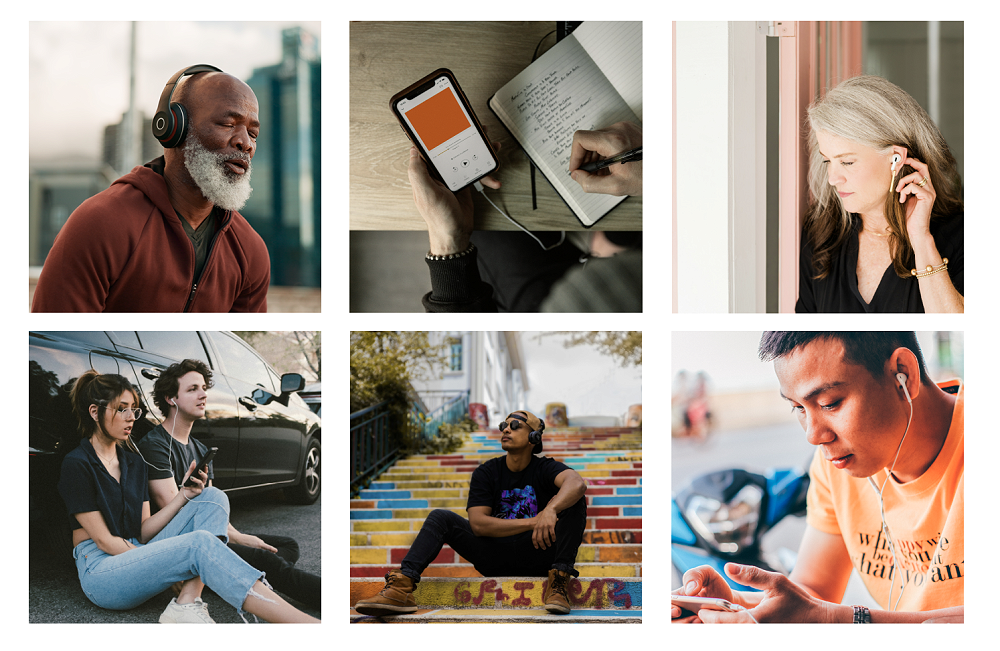
Perhaps the most powerful part of Pray As You Go is praying with a community. I may be quietly at home, others may be on a bus, trudging around their neighbourhoods, or breastfeeding a child on the couch. “In the scripts we often ask people to pray for the others listening,” Holland says. “There is a unity with God.”
Even though those praying are distanced by thousands of kilometres, God is among us all, uniting us through headphones and wi-fi routers. We might be paramedics or parents, students or workers, in Auckland or London or beyond but when we push play, we are joined and we turn our hearts towards God.
Tui Motu Magazine. Issue 289 February 2024: 22-23