
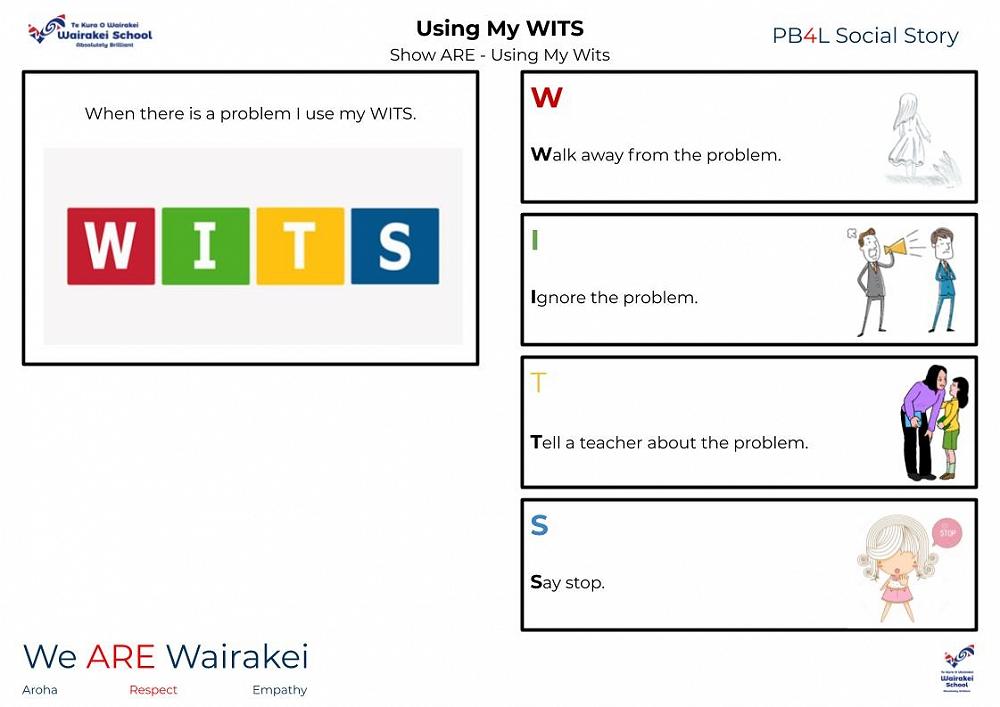
Using My WITS: A We ARE Wairakei Social Story
This social story is used to show children how we should solve social problems. The story shows that when any problem is happening to us there are always four actions we can take.
At School
These four actions can happen in any order. In any given situation some actions will work better than others. We teach the children that depending on the others involved that some actions are better than others. We also teach the children that sometimes several actions have to be attempted.
We also use this social story when we are resolving a negative behaviour. We discuss with the children which actions would have worked.
Walk away from the problem -This is walking off from a problem. This might be when the problem isn't happening to you, but is happening around you. It might be a situation where the problem is deliberately targetted at you, therefore walking away leaves it behind.
Ignore the problem - This is especially good if you think the problem isn't intentional. An example we use is if one group's ball bounces into you and your quiet game.
Tell a teacher about the problem - Of course this doesn't need to be a teacher. It can be any adult. We teach the children that they aren't just telling a teacher; they're actually telling a teacher about the problem. This is the difference between so-and-so is annoying me and my game is getting interrupted with another child running through it. The discussion between teacher/adult and the child that follows will establish the details of the problem and those involved.
Say stop - We teach the child that this one is particularly effective with close friends and respected peers. Simply telling them you've had enough can be a simple and quick solution.
In some cases when we work one on one with children experiencing a repetitive problem we direct them beyond choosing from WITS to us selecting them for them. In particular, we often use walk/run away from the problem in order tell a teacher/ask for help. This is an effective tool when a child just isn't in the right from of mind to choose wisely from the WITS menu for themselves.
At Home
This social story is most likely to be used at home in two ways. One way would be to address a frequent reaction to a frequent problem. In this case the adult would pick the appropriate WITS response and encourage it. eg when your brother throws the lego walk away and tell me. The second way would be to encourage a good skill for when it is needed. In this case the adult and the child would regularly talk about the steps. In the event of the child using a WITS action the adult praises the success.
In general, We ARE Wairakei social stories illustrate positive behaviours that can be actively done. Therefore children can be spotted doing the positive behaviour. Therefore they can be praised and acknowledged for doing the positive behaviour. Although they are written with school in mind, the content is very easily reused or adapted for the home.
The best behavioural changes come from adults promoting positive behaviours that can be observed and praised. Tell a child the positive thing you need to see, praise and acknowledge when you see them doing it.