Bullying
Whether bullying is physical, verbal, emotional or online (cyberbullying), there are four factors that can be used to identify bullying.
- Bullying is deliberate – intentionally causing physical and / or psychological harm to another person.
- Bullying involves a power imbalance – an actual (or perceived) unequal relationship between those being bullied and those who bully. For example due to physical size, age, gender, social status or digital capability and access.
- Bullying is usually not a one-off – it is repeated over time, with the threat of further incidents leading to fear and anxiety. People may bully one person many times, or different people each time.
- Bullying is harmful – there is short or long-term physical or psychological harm to the target (eg, as a result of coercion or intimidation).
When it’s not bullying
Bullying is one particular form of aggressive behaviour. Not all verbal or physical aggression is bullying. For example, if a student offends someone by making unintentionally sexist or racist remarks, it is not bullying.
Is it bullying, fighting or hassling?
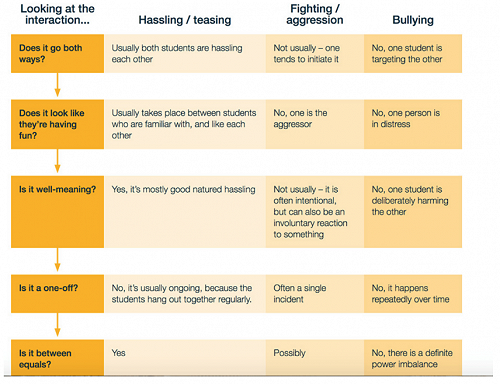
Often the term bullying gets used to describe other behaviour, such as hassling between friends which sometimes can go a bit far, or an aggressive reaction from a student who has been involuntarily provoked by another. Attached are some key questions which help show the difference between bullying, fighting and hassling.
Great resources can be found at this link. From the bullyingfree.nz website
Gallery