Tīaho: Learner Habits and study strategies for progress & success
“We are what we repeatedly do. Excellence, then, is not an act, but a habit.” - Will Durant (American Historian and Philosopher)
In our previous blog we outlined the philosophy behind the ‘character and well-being’ side of our Tīaho programme. This sets a foundational understanding for students so that they know themselves, how their brain works, and how they will develop as individuals. It also helps to give them a sense of belonging at Wellington College, both in terms of the current school community, and the rich history of the college.
As students progress towards the senior school, the focus of the Tīaho programme shifts to practical habits and study strategies that they can adopt.
Laying the groundwork
In 2024 we began to implement aspects of A Learner’s Toolkit which exposed students to evidence based study skills that have proven to be highly effective. This was addressed in several contexts such as teacher professional development, year level tutor classes, and more targeted sessions in the Year 11 Skills for Life class. Senior students were also given a ‘study pack’ with resources related to the study strategies as they departed for the external examinations. Finally, Wellington College hosted a combined NCEA day with Wellington East Girls College to prepare Year 11 students for their first full NCEA courses the following year. On this day, a ‘Learner Habits’ workshop was run to prepare students to develop good learning habits.
Tīaho 2025
In 2025 we made a decision to dedicate more time for these essential skills, and move beyond teaching students about the strategies, but rather giving them more time and support to implement them. As teachers, we often talk about the lofty goal of creating ‘life-long learners’, but through this programme we are actually giving them the time and space to develop the skills that will lead to this outcome.
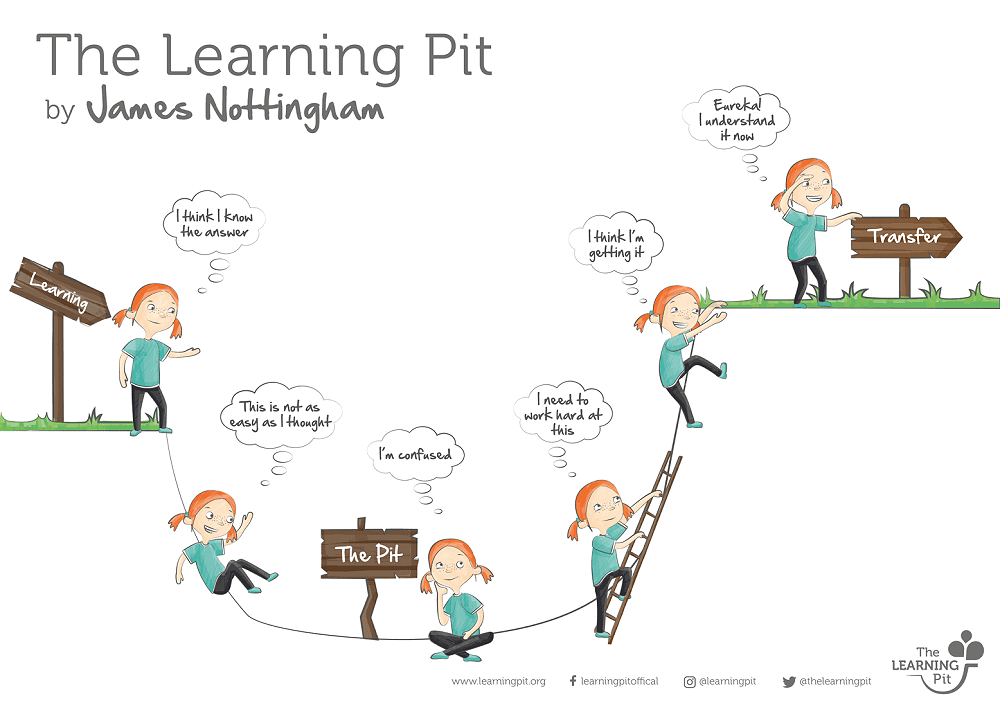
We started the year by talking about the idea that learning is difficult. We used the concept of ‘The Learning Pit’ (Nottingham, J. 2017) to emphasise to students that the moments of struggle are when the learning is most likely to take place, and that they should not be deterred by this. For teachers, we addressed this through the concept of ‘productive struggle’, encouraging them to resist the urge to ‘rescue’ the students as soon as they seemed to be going down the wrong path, but rather allowing them to learn from their mistakes.
To help students understand and form good habits, we took inspiration from author of Atomic Habits, James Clear, who said: "You do not rise to the level of your goals. You fall to the level of your systems." With this advice in mind, it was important to give students some advice on how to form good habits that would allow them to work towards their goals. For this, we implemented some of Clear’s strategies such as making a ‘habits scorecard’ in which students would rank their current habits, and consider whether they were positive, negative, or neutral habits. In doing so, they could make decisions about what changes they needed to make to their habits. Students were then introduced to habit forming strategies such as the ‘two minute rule’, and ‘habit stacking’ to show that it was more effective to make subtle changes to their habits, and integrate new habits with their existing habits. Once a habit was firmly established, then they could think about how to strengthen it. Someone who doesn’t usually read at home shouldn’t make a goal of reading for an hour every night for example, because the change is too big, and they will be deterred when they don’t keep up with it. Instead, they could start by placing their book on their bedside table as a reminder, and read a couple of pages each night. As time passess, they will slowly build this up until reading for an hour doesn’t seem like a huge leap, but a gradual shift.
So what are good learning habits? For this, we still rely on the strategies from ‘A Learner’s Toolkit’. Strategies such as ‘Retrive it’ (Retrieval Practice), and ‘Visualise it’ (Dual Coding). In 2025 our mission is to provide greater opportunities to practice these strategies in a variety of modes, so that they become a habit, but never one that is stale or mundane. We will continue to monitor this through student and teacher surveys, as well as looking at how our results track over time; knowing that study skills and habits will complement the many other initiatives that both students and teachers use to raise student achievement and well-being.
References
Nottingham, J. (2017). The learning pit: A guide to challenging thinking. Nottingham: Challenging Learning.
Clear, J. (2018). Atomic habits: An easy & proven way to build good habits & break bad ones. New York, NY: Avery.