

Principal's Message - Mid-Term 2, 2026

The last two weeks has seen a flurry of information coming from the Ministry of Education in relation to new curriculum implementation at years 11 to 13 and new qualifications planning, now that it has been announced that NCEA will be replaced.
These changes will affect the current cohort of year 9 students. Year 9 in 2026 are being taught the current version of the New Zealand Curriculum (NZC) in all subjects except Mathematics and English (where they are taught against a new curriculum implemented this year). They will move to the new curriculum across all learning areas in year 10 with further new curriculum documents being released currently for implementation when those students are in years 11 to 13.
Further, this same cohort will be the first candidates for the new Foundational Award for Literacy and Numeracy in 2028, the new New Zealand Certificate of Education (NZCE) in 2029, and the New Zealand Advanced Certificate of Education (NZACE) in 2030.
The release of curriculum documents and further information about the qualification means that we have a little more idea of what assessment may look like in a post-NCEA world. Unfortunately, it looks a little like assessment in a pre-NCEA world. The graphic below indicates what a Year 12 award may look like.
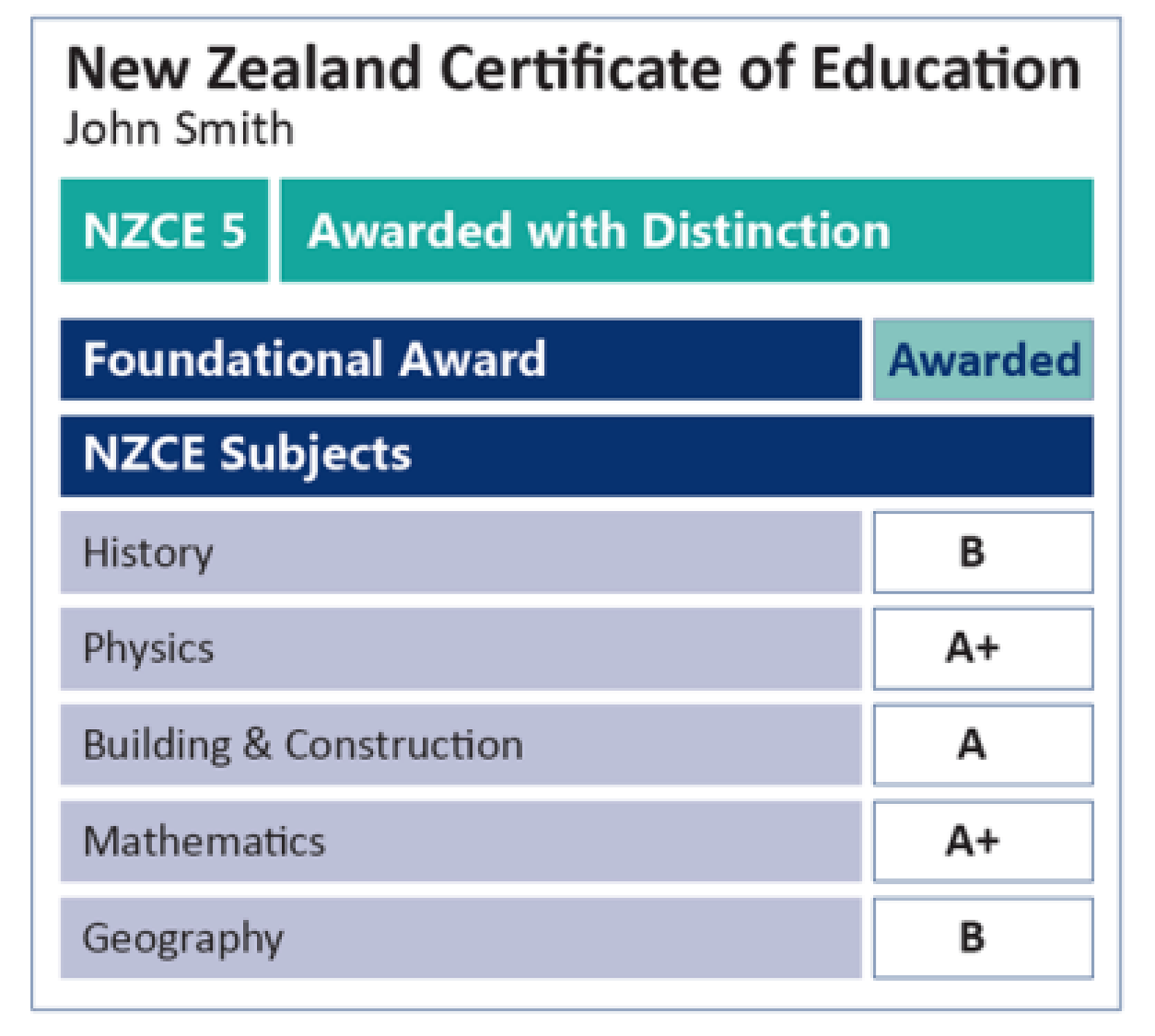
At this stage, it has been announced that there will be a 6 point grading system ranging from A+ to E (A+, A, B, C, D, E). You can probably guess why the A+ is in there, because without it, the 6 point system would land on an F at the end, which probably wasn’t palatable for the devisors of this system.
A student has “passed” a subject if they have attained a grade of C or better and they are required to ‘pass’ at least three subjects to be awarded the Certificate. You may notice that this certificate says NZCE 5 which means they passed five of their subjects. That sounds great for our high achieving students and NCEA currently recognises those students very well through subject and certificate endorsements.
An alternative look for this certificate may have had a B for History, a C for Physics, an E for Building and Construction, an A for Mathematics, and a D for Geography. Such a certificate would indicate that the student has passed three subjects so they are awarded the new certificate and it would indicate their strength in three areas (History, Physics and Mathematics) and their weakness in two areas (Building & Construction, and Geography). And that is a big shift from NCEA and one I am against, although of course I know that my view clearly isn’t shared by all.
One of the best features of NCEA is that it is a strengths-based qualification. The record of achievement focuses only on what a student can do, not what they can’t do. If a student is short of the qualification for their year, then it recognises their achievements in that year, through the credits they achieve, and the cumulative nature of the qualification, tells them that if they stick at it, they will be able to achieve that qualification, most likely, during the next year.
The new qualification will show what a student can do, and what they can’t do which means that a student who has a certificate full of Ds and Es will have a record that they can’t do anything, really, and that’s a depressing prospect. We don’t yet know what the implications are for students who don’t pass anything or only pass 1 or 2 subjects.
The highly respected educator Bali Haque, who has had four Principalships and was the Deputy Chief Executive Officer at NZQA from 2006 to 2011, has described the changes as “back to the future” and “a disaster in the making”. I sincerely hope he is wrong but it is hard to work out how the new system as proposed, is a step into the future. It’s certainly a step into the past. And the curriculum documents that have been released simultaneously with this announcement also seem like a step into the past.
I have made the point in previous messages that a good education system should be able to recognise what students can do and reward them for that through the qualifications that it offers. It seems obvious to me that students should be achieving because of the system they are in, not in spite of it. For example, a gifted musician who cannot read or write music can currently achieve at least 20 credits through performance and composition standards in level 2 (nominally year 12) Music. A substantial part (about a third) of their qualification will be recognised in their music achievements. The new music curriculum for years 11-13 has not yet been released so I don’t know if it will be possible to recognise someone’s achievement in a similar way.
The qualifications release document says that “students can generally expect around three to four assessments per year for each subject including one exam” which I assume is some sort of external assessment. If this is the case in music, I doubt there will be the recognition I have outlined above, and that talented student may be confined to a D.
That’s a great loss but perhaps I can allay my fears for the new curriculum and qualifications by the knowledge that many things I have experienced in education in my career over nearly 40 years, have been cyclical, so perhaps in my twilight years I can expect someone very clever to invent a system of assessment that credits all the achievements of a student, across a wide variety of disciplines in an ingenious fashion, that’s envied by the rest of the world. Perhaps they’ll call it the new National Certificate of Educational Achievement!