The challenges of education and proposed solutions from Pasi Sahlberg
Last week I had the opportunity to attend the annual NZ Principals' Federation conference in Queenstown. The keynote speaker was Pasi Sahlberg, a Finnish education expert, author and professor at the University of Melbourne in Australia. Previously, he has worked as a professor of practice at Harvard University at the World Bank, and as the director of the Centre for International Mobility in Finland.
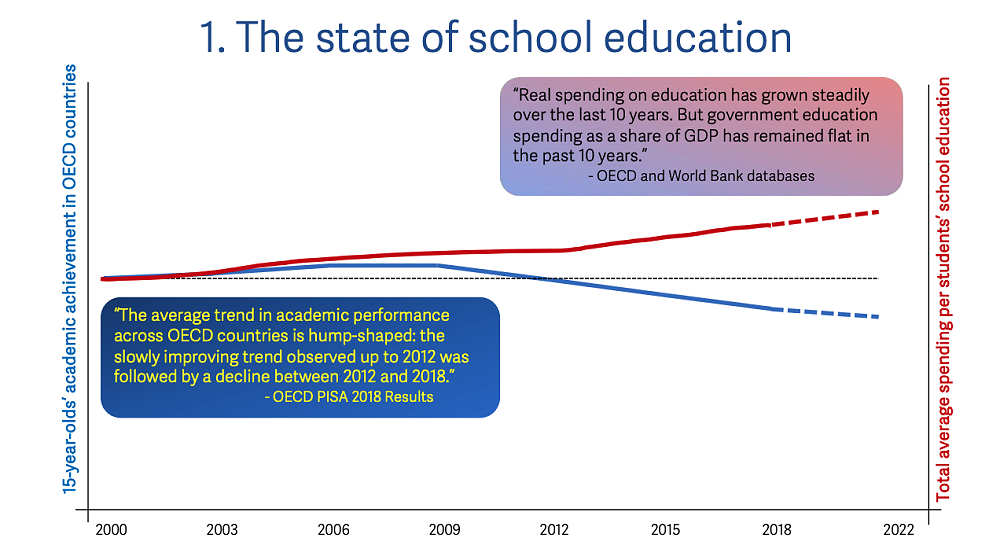
While we hear a great deal in the media about a decline in NZ educational achievement, we don't often hear that this is part of a worldwide trend. Pasi shared an analysis of OECD achievement data in all OECD countries, noting that across all OECD countries, as educational spending had increased, student achievement had decreased.
He identified that the key reasons behind the trend of declining achievement rest largely outside of school. His research identified:
- increasing levels of financial poverty;
- the influence of social media and other distractions;
- reducing levels of literacy and readiness for school activities undertaken within the home;
- children's reduced ability to be able to entertain themselves without external stimulation; and
- children's significantly reduced attention span.
Sahlberg noted that this decline was first noticed in the early 1980s. Previous international responses to this decline led to the failed Global Education Reform Movement, GERM, which called for a 'back to basics' curricula; test-based accountability; school choice; and de-professionalisation.
While this might seem a little 'doom and gloom', Sahlberg shared some solutions to the problem too. While several require significant government support (financial or legislative) there are some things that individual schools can do.
He argues for the universal benefits that come from:
- free school lunches for ALL children, ensuring increased social interaction while sitting to eat, as well as full tummies. (It's appropriate to note that he bases this on canteen-style lunches in Finland rather than the delivered lunches available in NZ's 'Lunches in Schools' scheme);
- music in every primary school. To be accepted into teacher training in Finland, candidates need not just academic and social aptitude - they have to be able to play an instrument and teach music;
- better relationships through 'looping' where teachers keep the same class for several years, moving up the school with them. In this way, they 'hit the ground running' each year as they know each student's achievement and needs intimately and they have strong connections with children and whānau; and
- regular short breaks during the school day to allow the learning programme to be structured to optimise students' shorter attention spans.
While our students' achievement remains high, our leadership team has begun the process of examining these initiatives and identifying ways in which we might be able to build on some of them to leverage benefits for our students. We look forward to sharing some with you over the next 18 months.
Gallery