Restorative Justice
Restorative Justice is an approach that focuses on the needs of victims and where wrong doers are encouraged to take responsibility for their actions and to repair the harm they've done.
Restorative Justice is based on a theory of justice that considers wrong doing to be an offence against an individual, groups of people and or the school community.
Many of us were brought up when parents and teachers were authoritarian and punitive-they found out what happened, what rule was broken, who was to blame then applied a punishment. This approach, often a quick fix, made the person in authority feel powerful and satisfied the need to inflict revenge or shame. In this approach authority is not questioned, compliance is demanded and others do as they are told.
Restorative Justice is a way of seeing that inappropriate behaviour in this case at school causes harm to people, relationships, and the school community. We believe a just/fair response is needed to deal with any wrong doing. The best way to do this is for the people involved to meet to discuss the harms and how to bring about resolution and move on.
For restorative practices to be effective in changing behaviour we ask students questions to foster awareness of how others have been affected by their actions. If we just punished students they see themselves as victims which distracts from noticing others feelings. Restorative practices encourage students to take responsibility for what they have done and to see any wrong doing as an opportunity to learn.
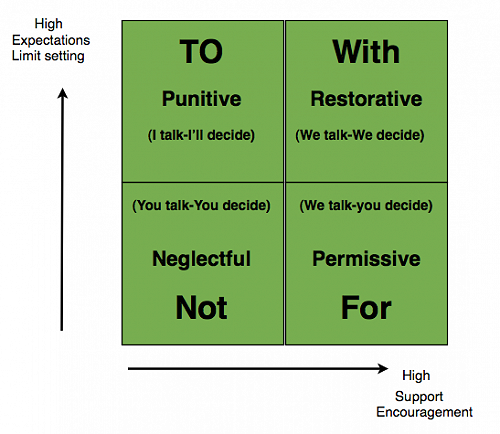
The interesting thing about the Social Discipline Quadrant is that it can apply to school, home, work and other community settings. It is all about the relationship that exists between individuals or groups of people eg. students, parents, staff, adults.
The aim is for students, staff and families to be operating with others where there are high expectations and high support. This is Restorative Justice in action where all involved are accountable for their actions, reasonable and flexible.
Where high expectations only exist with no support this is a punitive environment. Students, staff and families could find themselves being dealt to by someone who is authoritarian and confrontational.
Where there is just high support this is a permissive environment. Students, staff and families could find themselves rescuing and or excusing inappropriate behaviour for others.
The final quadrant is where there are no expectations and no support. Students, staff and families could find themselves not being cared for or neglected.
In trying to make change and or to relate to others (in any setting) in the Restorative Quadrant the following are helpful hints-
- Spend time on growing relationships
- Listen first-be quiet
- Think about the outcome wanted before deciding on an approach
- Help the wrong doer understand what harm has been done
- Work on putting things right rather than punishing
- Role model restorative practices
A child’s brain and development is work in progress. Adults (parents and staff) will find it much easier to be relating to others and solving concerns within the restorative quadrant. This is where we talk and decide on things together. Restorative practices fit like a glove within our Intelligent Behaviours-
- TEAM PLAYERS are Respectful, Kind, Caring, Honest and can show Empathy.
- SELF MANAGERS are Courageous, Confident, Disciplined, Persistent and Resilient.
- LOGICAL THINKERS are Reflective, and can Inquire, Problem Solve and Think Critically.
- CREATORS are Creative, Curious, Flexible, Adaptable, can Think Outside The Square and have a Sense of Humour.
At Woodend School our hope is that students, parents and staff apply restorative practices in all interactions be they student to student, student to staff, students to adult or parent to staff.
This brief summary of Restorative Justice has been adapted from information provided by Margaret Thorsborne and Associates 2011. Most of our staff are trained by Margaret in Restorative Justice.
We continue on our restorative practice journey and invite you to be part of it with us. Should you have any questions or comments please contact us by ringing the school.
Gallery